
No products in the cart.
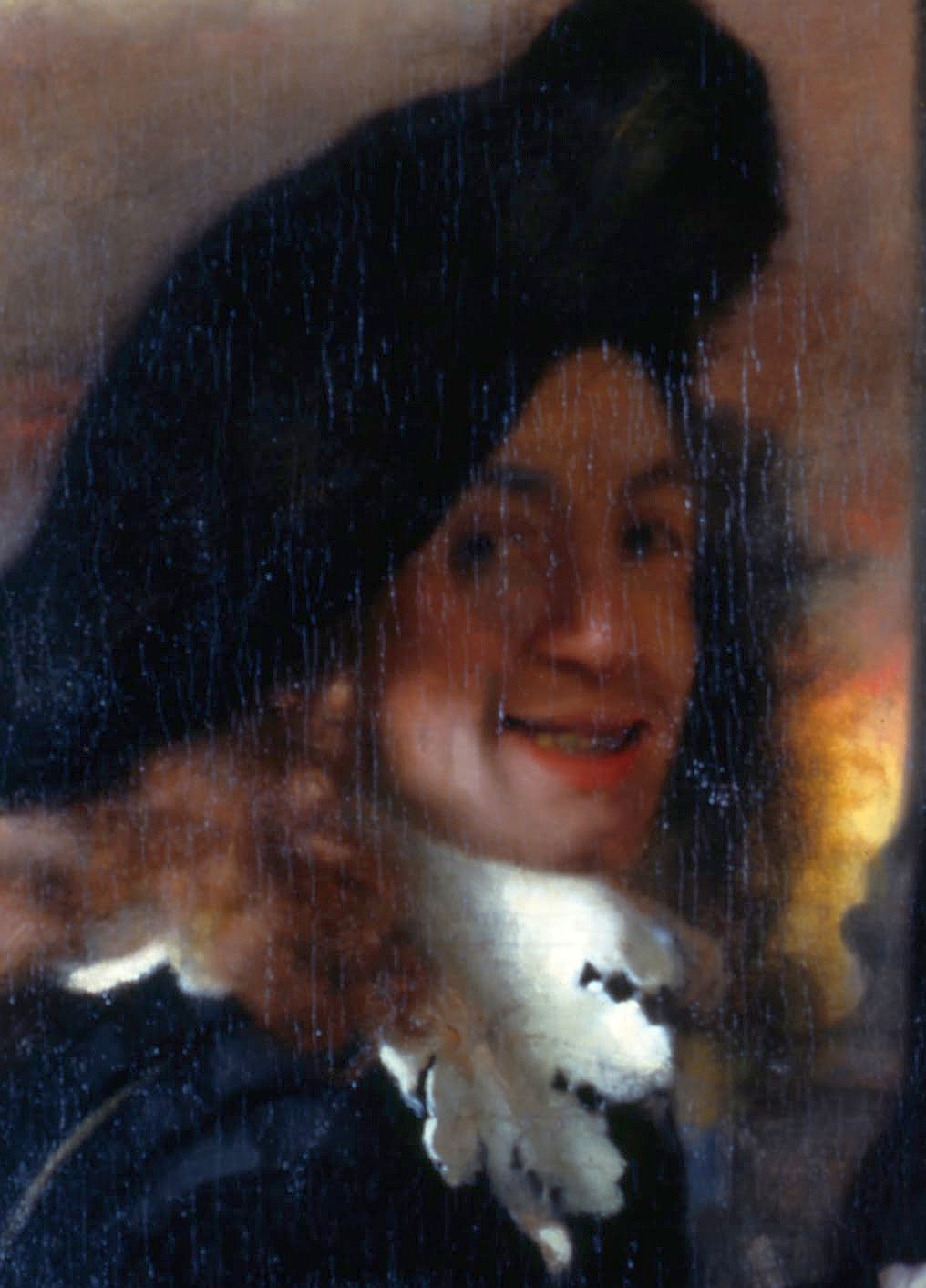
Top Artist of History: Johannes Vermeer – Master of Domestic Scenes
A woman pours milk into a bowl. Another reads a letter beside a window. Someone sits at a keyboard. A young woman turns towards us wearing an extraordinary pearl earring.
Nothing much seems to happen in the paintings of Johannes Vermeer.
That is precisely why they are so extraordinary.
Vermeer transformed ordinary rooms, everyday objects and quiet moments into some of the most memorable paintings in Western art. His interiors contain no great battles, heroic crowds or theatrical gestures. Instead, a shaft of daylight falls across a wall. A piece of fabric catches the light. A chair stands slightly away from a table. Someone pauses over a letter.
Time seems to slow down.
Johannes Vermeer is now considered one of the great painters of the Dutch seventeenth century, yet his surviving body of work is remarkably small. Only around three dozen paintings are generally accepted as his, and much of his life remains uncertain.
What we do know reveals an artist with an extraordinary understanding of light, colour, perspective and visual balance.
Vermeer could make a simple room feel mysterious.
He could turn a domestic task into a monumental image.
And he could make silence visible.
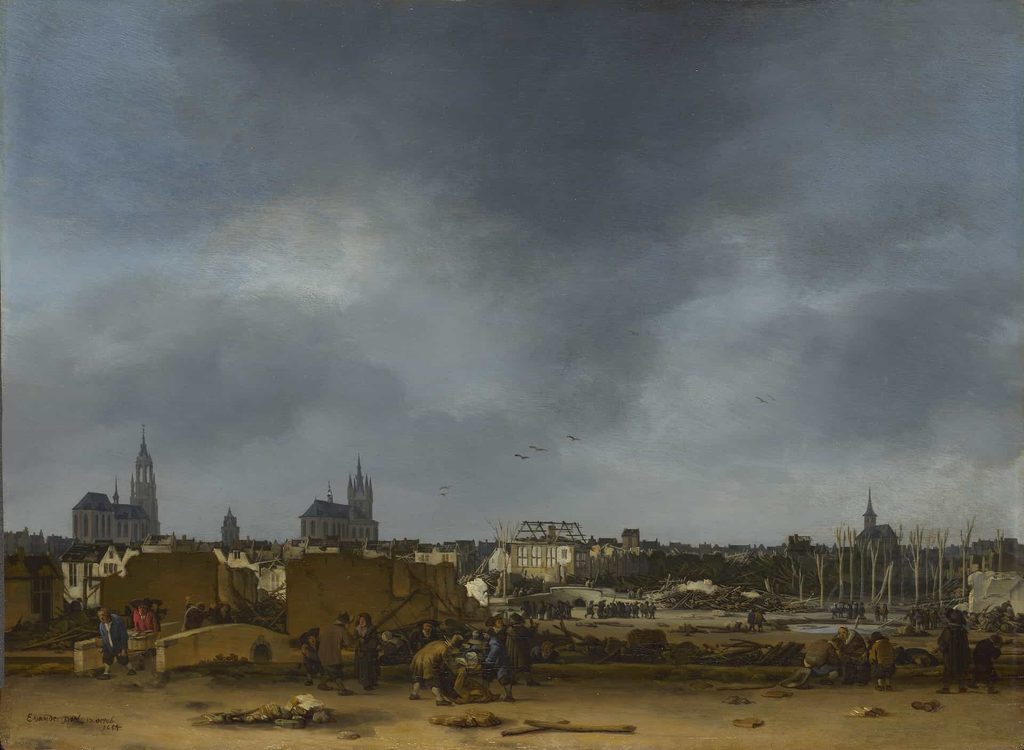
Who Was Johannes Vermeer?
Johannes Vermeer was a Dutch painter born in Delft in 1632. He lived and worked in the city throughout his life and died there in 1675, aged only 43.
Today he is closely associated with the Dutch Golden Age, a period of extraordinary artistic activity in the seventeenth-century Netherlands.
His full name is generally given as Johannes Vermeer, although historical records contain several variations of his surname.
Very little is known about his artistic training.
There is no surviving document telling us exactly who taught him to paint. Various artists have been suggested as possible teachers or influences, including Leonaert Bramer and Carel Fabritius, but the evidence remains uncertain.
What is known is that in 1653 Vermeer became a master in Delft’s Guild of Saint Luke, the professional organisation for painters and other artists.
He later served as head of the guild more than once, suggesting that he was respected within Delft’s artistic community.
Vermeer was not simply a painter. He was also involved in the art trade, following a connection established by his father, who had worked as an art dealer and innkeeper.
In 1653, Vermeer married Catharina Bolnes. They had a large family, with records indicating that Catharina gave birth to fourteen or fifteen children, although not all survived childhood.
The quiet rooms in Vermeer’s paintings can therefore seem surprising.
The real household in which he lived was probably anything but quiet.

Why Is Johannes Vermeer So Famous?
Johannes Vermeer is famous above all for his ability to make ordinary life feel extraordinary.
His best-known paintings are usually small domestic scenes.
Women read letters.
People make music.
A maid pours milk.
A woman makes lace.
A figure looks into a mirror.
Another stands beside a window.
These are not dramatic subjects.
Vermeer’s achievement lies in what he does with them.
He controls light, colour, perspective, objects and empty space so carefully that the scene begins to feel suspended outside ordinary time.
His paintings can appear almost photographic from a distance, yet they are not simply exercises in realism.
Look closely and something different happens.
Edges soften.
Small dots of paint become highlights.
Objects are simplified.
Some details disappear entirely.
Colours are adjusted to create harmony rather than merely copy reality.
Vermeer gives us enough information to believe in the room while controlling every part of it as a painter.
That tension between reality and construction is central to his work.
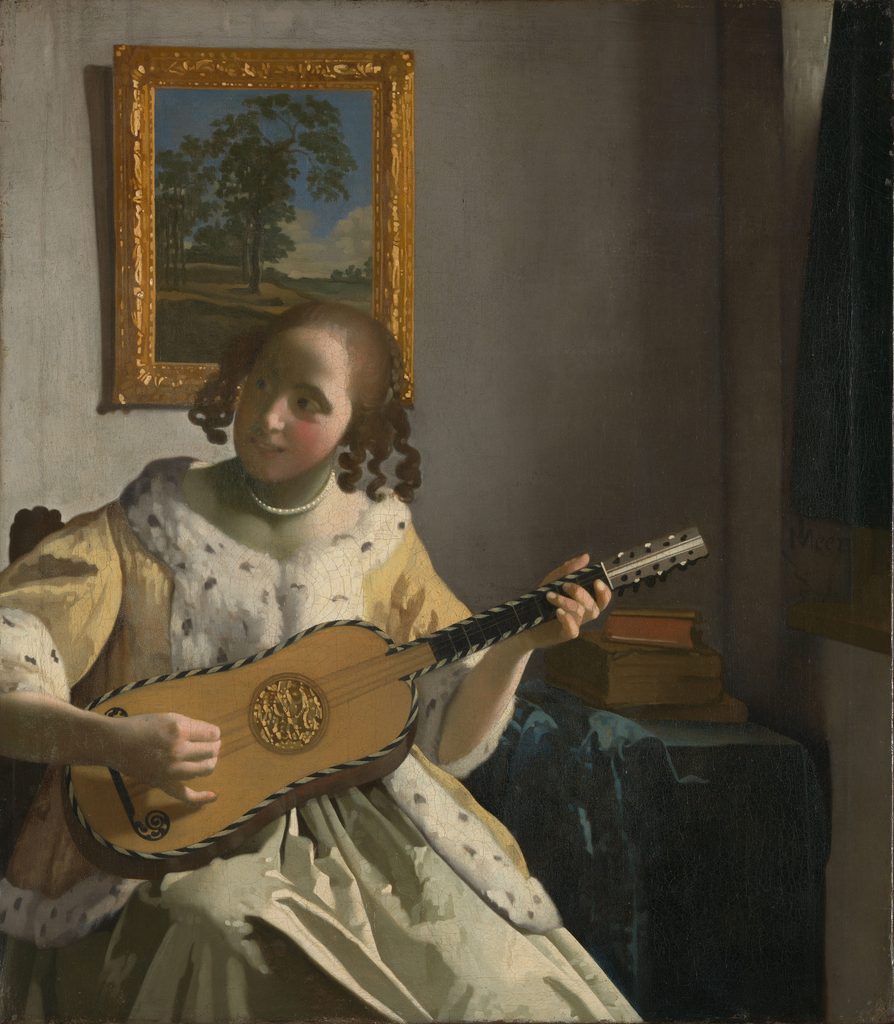
Johannes Vermeer and the Dutch Golden Age
To understand Vermeer, it helps to understand the world in which he painted.
The seventeenth-century Dutch Republic became one of Europe’s major centres of trade, science, publishing and art.
A growing merchant class created a large market for paintings.
Unlike earlier periods in which artists often depended heavily on churches or royal courts, Dutch painters produced works for private homes and collectors.
This created demand for many different kinds of painting.
Portraits
Landscapes
Still lifes
Marine paintings
City views
Flower paintings
Scenes of everyday life
These everyday scenes are often described as genre paintings.
Artists including Pieter de Hooch, Gerard ter Borch, Nicolaes Maes and Gabriel Metsu painted interiors, families, servants, musicians and domestic activity.
Vermeer belonged to this wider culture of Dutch genre painting.
Yet his work feels distinct.
His rooms are unusually controlled.
The number of figures is often small.
The architecture is carefully arranged.
Objects appear to have been selected rather than accumulated.
Most importantly, light seems to organise everything.
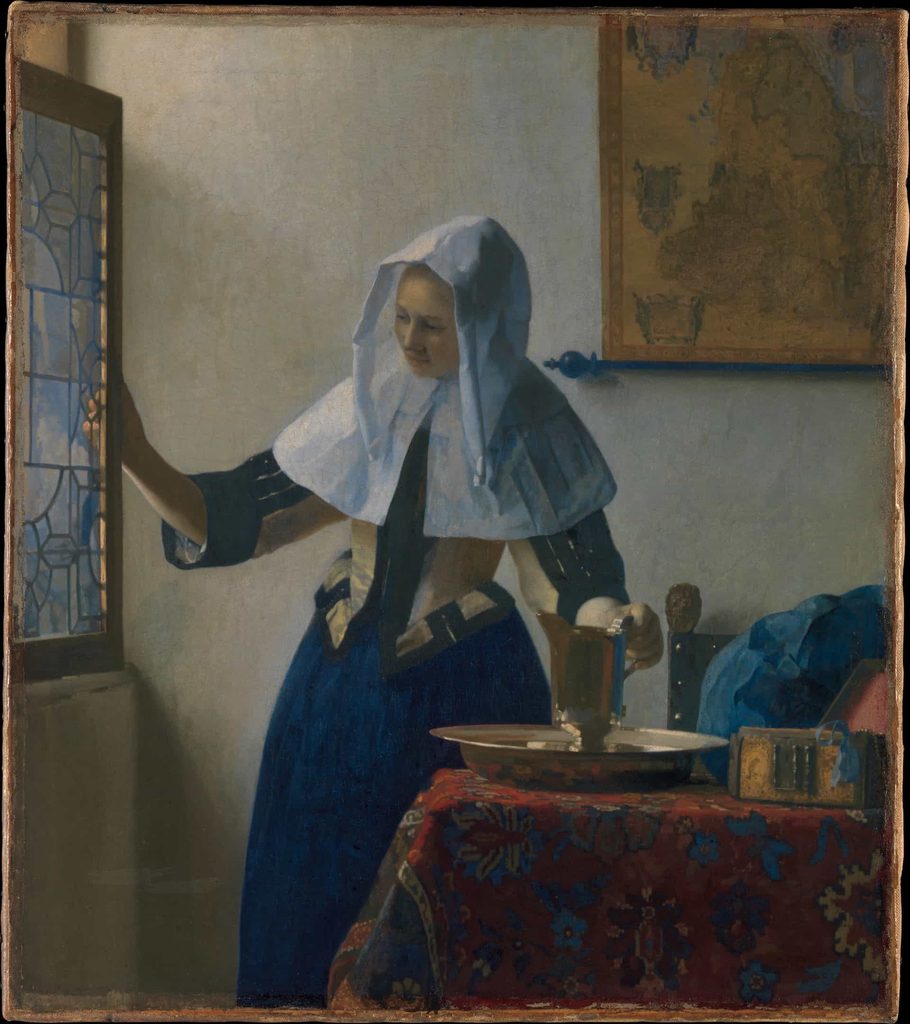
Johannes Vermeer and Domestic Scenes
Vermeer is often described as a master of domestic scenes.
It is a good description, but it can make his paintings sound more ordinary than they really are.
He was not simply documenting seventeenth-century homes.
He was constructing visual worlds.
Many of his mature paintings show one or two figures inside an interior. Windows frequently appear on the left. Light enters the room and travels across faces, fabrics, walls, tables, maps, tiles and objects.
The figures are often occupied by something.
Reading.
Writing.
Making music.
Pouring liquid.
Making lace.
Looking.
Waiting.
These activities create concentration.
The people rarely seem aware of us.
We become quiet observers.
This is an important part of the experience of a Vermeer painting. The viewer often seems to have entered a private moment without disturbing it.

Why Are Women So Important in Vermeer’s Paintings?
Women dominate many of Vermeer’s most famous interior scenes.
They read letters, write, play musical instruments, make lace, pour milk and stand at windows.
Why?
Part of the answer comes from Dutch genre painting more broadly. Domestic interiors and women engaged in household or leisure activities were popular subjects in seventeenth-century Dutch art.
But Vermeer uses these subjects in a particularly concentrated way.
His women are rarely shown in frantic activity.
They are often absorbed.
A reader studies a letter.
A lacemaker concentrates on her threads.
A woman stands silently at a virginal.
The stillness gives these figures psychological weight.
We begin wondering what they are thinking.
A letter becomes more than a piece of paper.
A pause becomes a story.
A glance becomes a question.
Vermeer rarely tells us everything.
That uncertainty is one reason the paintings remain so compelling.
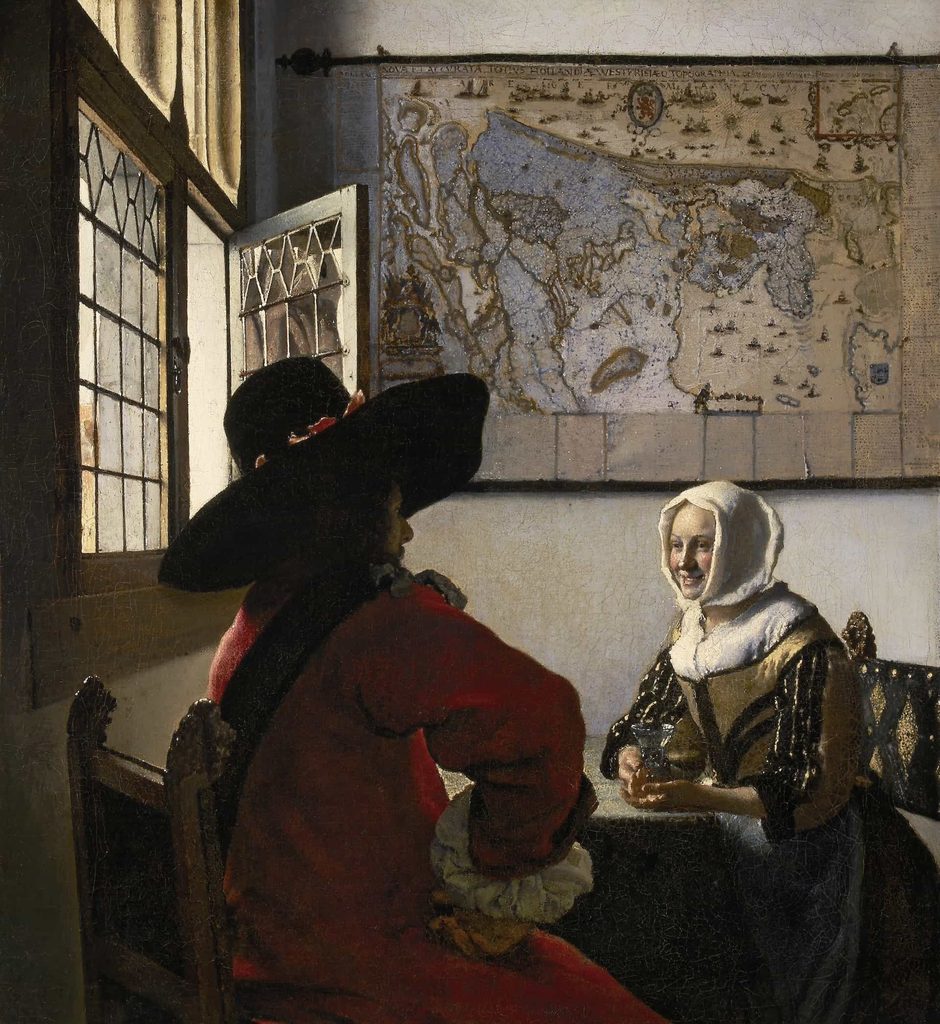
The Light of Johannes Vermeer
If one quality defines Vermeer’s art, it is light.
His paintings are famous for soft daylight that seems to enter naturally through a window.
Yet the effect is carefully constructed.
Light does several jobs at once.
It creates depth.
It describes materials.
It separates figures from walls.
It guides the eye.
It creates mood.
It makes ordinary objects seem important.
Look at a loaf of bread in The Milkmaid.
Small touches of paint make the surface glitter.
Look at a pearl.
A few marks can make it seem luminous.
Look at a white wall.
It is rarely just white. Light changes subtly across its surface.
Vermeer understood that light is not simply something that falls on objects.
Light determines how we see them.
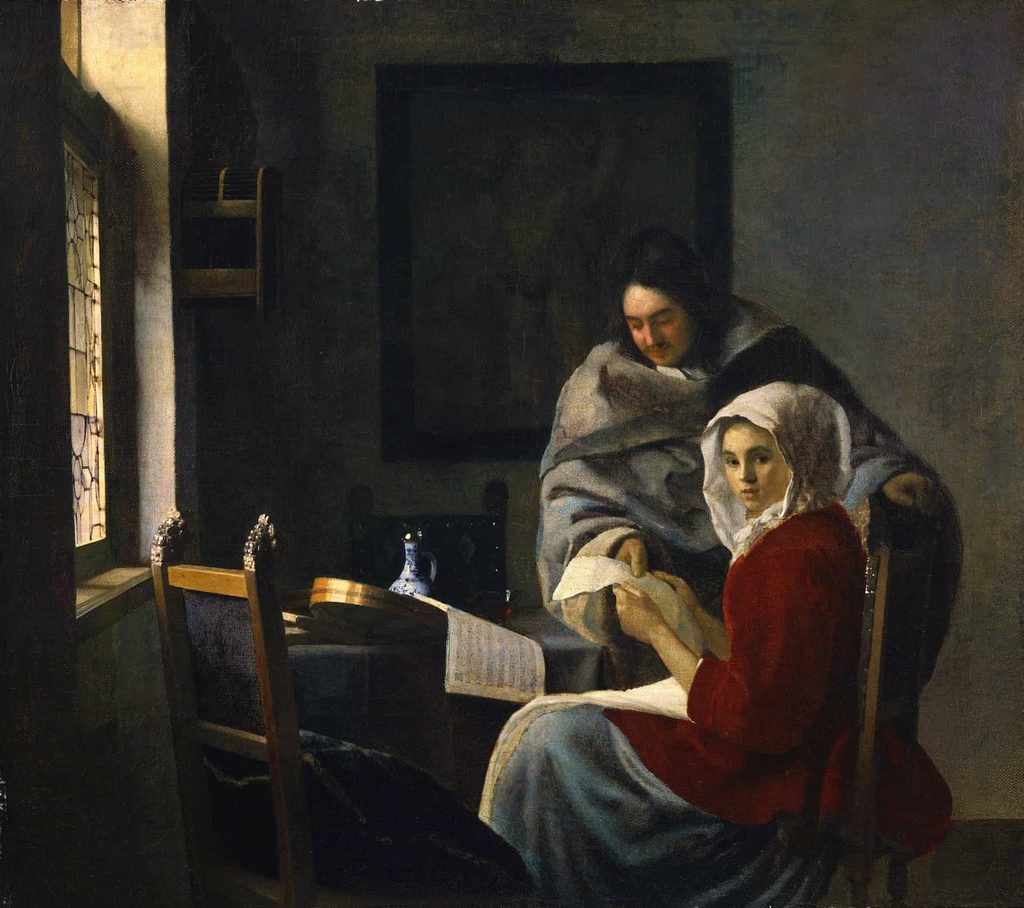
Where Does the Light Come From in Vermeer Paintings?
One of Vermeer’s most recognisable devices is a window positioned on the left side of the composition.
The window may be fully visible, partly visible or outside our field of view, but daylight enters from that direction in many paintings.
This repeated arrangement helps create the familiar atmosphere of a Vermeer interior.
Light travels sideways across the scene.
A face turns towards it.
A wall catches it.
Objects nearer the window appear brighter.
Areas farther away become cooler or darker.
Yet Vermeer’s lighting rarely feels theatrical.
It feels observed.
That natural quality makes his paintings seem quiet even when the underlying composition is extremely controlled.
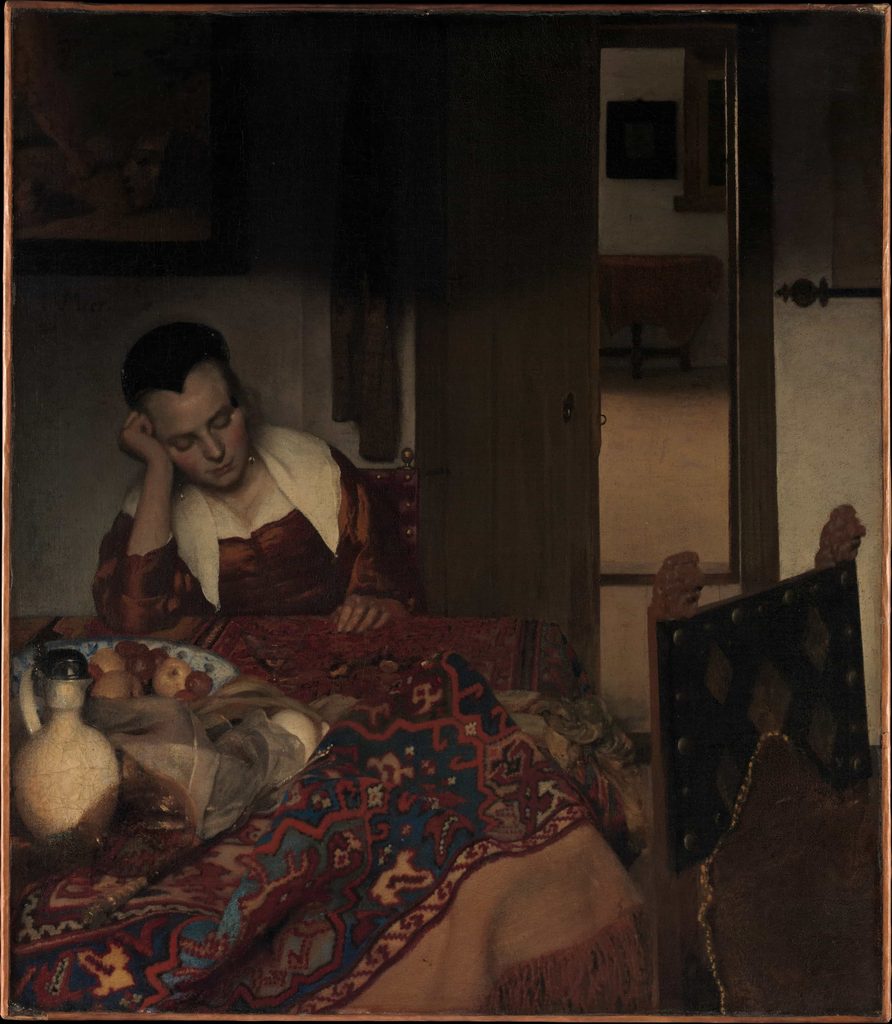
Johannes Vermeer and Colour
Vermeer was also a remarkable colourist.
Blue and yellow are particularly associated with his work.
Perhaps his most famous blue came from natural ultramarine, a pigment made from lapis lazuli.
This was an exceptionally expensive material.
Lapis lazuli came from distant sources, including Afghanistan, and high-quality ultramarine could cost more than many other pigments available to painters.
Vermeer used it generously.
More surprisingly, he sometimes used ultramarine in areas where viewers might not immediately expect blue, including shadows and underlayers.
This helped create coolness and depth throughout his paintings.
Yellow frequently appears alongside blue.
A yellow jacket.
A blue cloth.
A pale wall.
A red accent.
Vermeer’s palette can look simple, but the relationships between colours are extremely carefully controlled.
Nothing seems accidental.
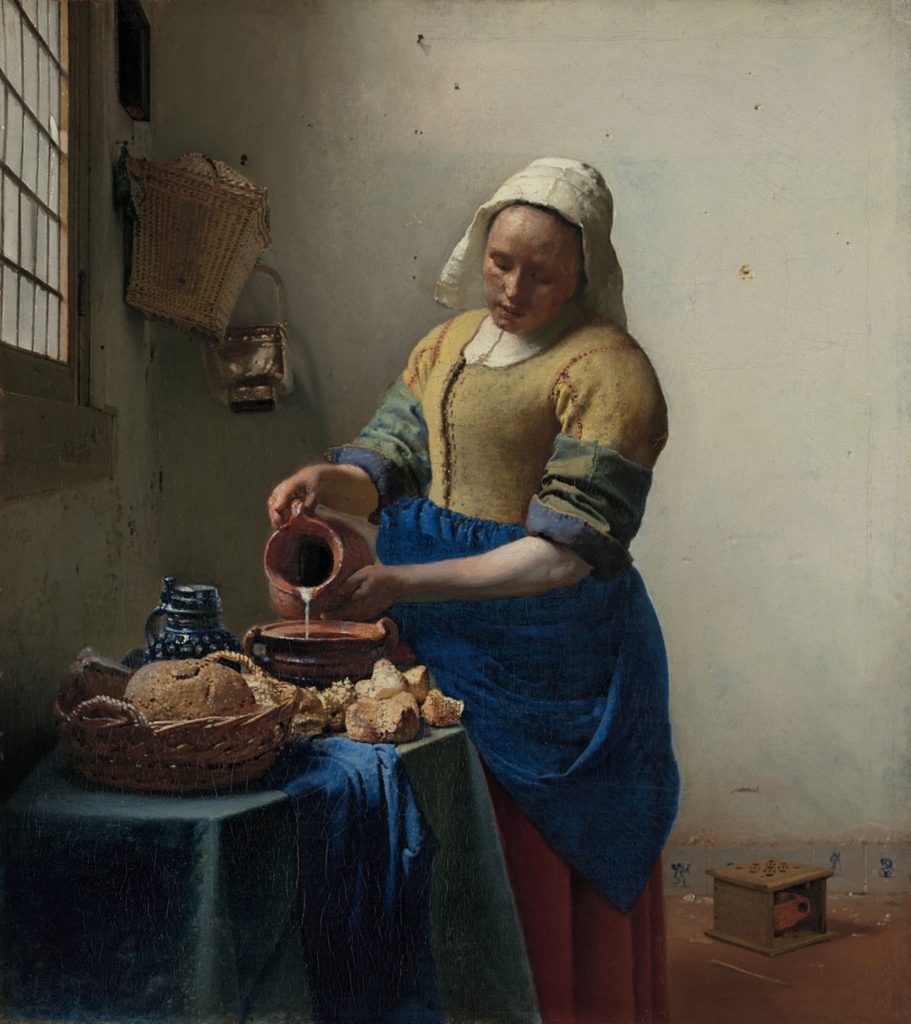
The Milkmaid: Making the Ordinary Monumental
The Milkmaid is one of the clearest examples of what makes Johannes Vermeer different.
The subject is simple.
A woman stands at a table pouring milk.
Bread lies in front of her.
There is a window to the left.
A plain wall fills much of the background.
That is almost all.
Yet Vermeer makes the woman feel monumental.
She is completely absorbed in her task.
The stream of milk provides one of the few obvious signs of movement.
Light catches the bread, jug, fabric and wall.
The room feels quiet enough to hear the liquid pouring.
Technical research has shown that Vermeer altered the composition as he worked. Objects originally planned for the background were removed or painted over.
That decision matters.
By simplifying the wall behind the woman, Vermeer made her presence stronger.
The painting demonstrates that composition is often as much about removing as adding.
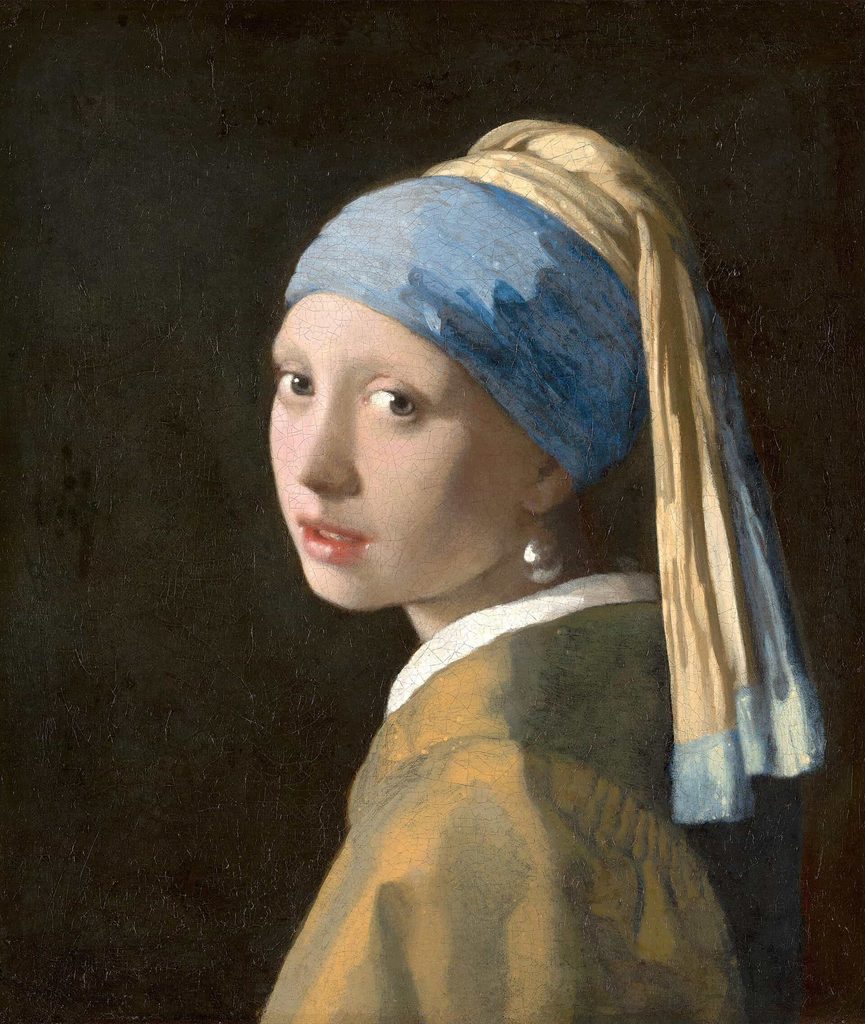
Girl with a Pearl Earring
Girl with a Pearl Earring is probably the most famous painting associated with Johannes Vermeer.
Yet it is often misunderstood.
It is not a conventional commissioned portrait.
It is generally described as a tronie.
A tronie was a type of painting popular in Dutch art that depicted a character, facial expression or unusual costume rather than a named individual whose identity was the main point of the work.
That explains some of the painting’s mystery.
Who is she?
We do not know.
She turns towards us against a dark background.
Her mouth is slightly open.
Light falls across her face.
A blue and yellow head covering frames her features.
And the famous earring appears as little more than a few carefully placed highlights.
The painting seems simple because almost everything unnecessary has disappeared.
There is no room.
No furniture.
No landscape.
No detailed story.
Only the figure and our encounter with her remain.
That simplicity has helped make Girl with a Pearl Earring one of the most recognisable images in art.
Is the Pearl in Girl with a Pearl Earring Real?
The famous earring has generated endless discussion.
What is striking from a painter’s point of view is how little Vermeer actually needed to describe it.
He did not paint a perfectly outlined spherical object.
Instead, the pearl is suggested through reflected light.
A bright highlight.
A softer reflection below.
Darkness around it.
Our eye completes the object.
This is an important lesson in painting.
Artists do not always need to describe everything.
Sometimes carefully placed information is more convincing than excessive detail.
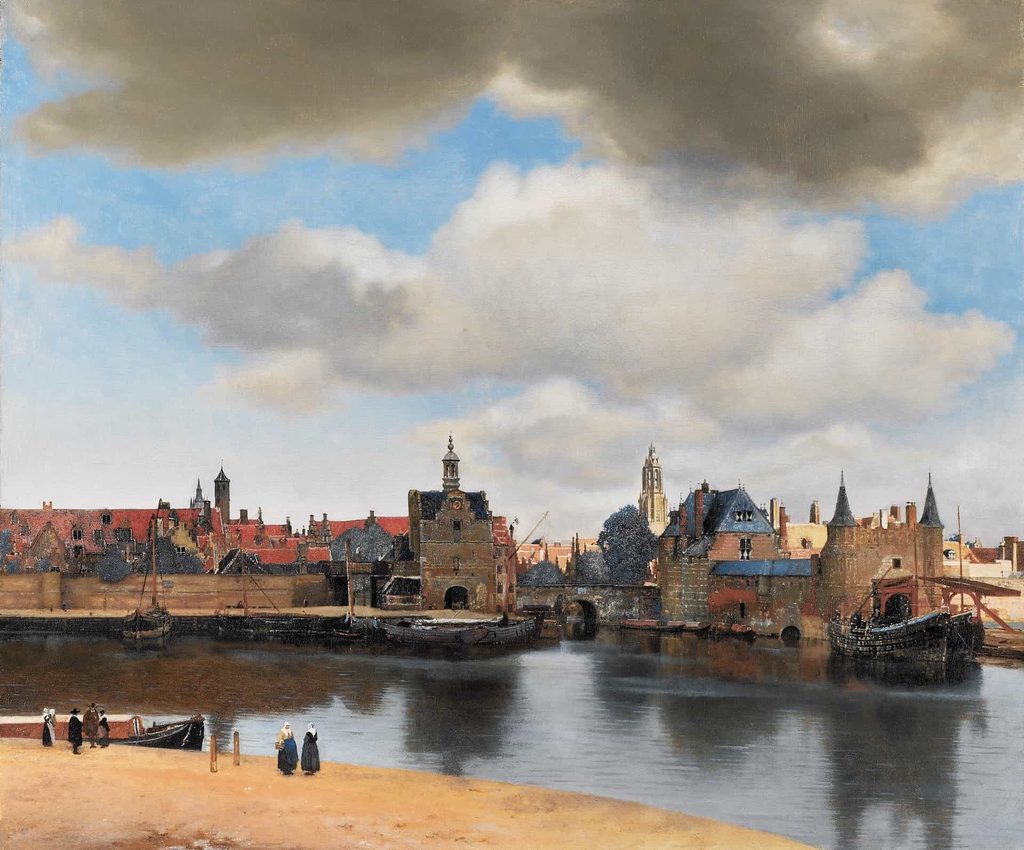
View of Delft
Vermeer is famous for interiors, but View of Delft proves how powerful he could be outdoors.
The painting shows his home city across the water.
Buildings stretch horizontally beneath an enormous sky.
Clouds move across the scene, creating alternating areas of light and shadow.
The city feels both solid and strangely quiet.
Again, nothing spectacular is happening.
Vermeer makes the ordinary appearance of Delft worthy of sustained attention.
The painting also demonstrates that his interest in light was not limited to windows and interior walls.
Here light works across an entire city.
Architecture, water, clouds and atmosphere become part of the same carefully balanced experience.

The Little Street
The Little Street takes an even more ordinary subject.
A brick building.
Doorways.
Windows.
A woman working.
Children nearby.
Again, Vermeer avoids drama.
The painting is remarkable because he gives architectural surfaces the same attention other artists might give a grand portrait.
Individual bricks matter.
Cracks matter.
Doorways matter.
Painted shutters matter.
The quiet life occurring around the building matters.
It is a painting about seeing value in the familiar.
That may be one reason Vermeer continues to feel surprisingly modern.

Woman Reading a Letter
Letters appear frequently in seventeenth-century Dutch painting.
They were useful narrative devices.
A letter immediately creates questions.
Who sent it?
Is it good news?
Is it a love letter?
What has the reader discovered?
Vermeer understood how powerful that uncertainty could be.
His letter-reading figures often seem completely absorbed.
The surrounding room becomes silent.
Instead of showing the story directly, Vermeer allows the viewer to imagine it.
This restraint is central to his art.
He gives us clues rather than explanations.
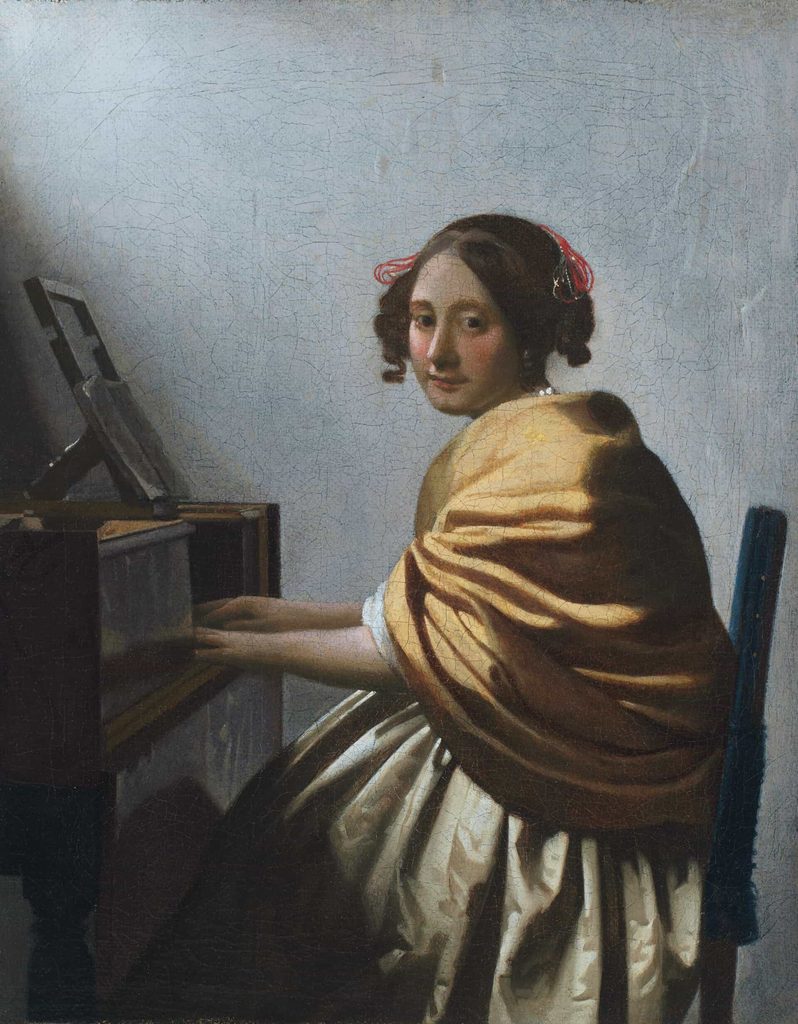
Music in Vermeer’s Paintings
Musical instruments also appear repeatedly in Vermeer’s interiors.
Virginals, lutes and other instruments were associated with leisure, refinement, courtship and harmony.
A woman at a keyboard may therefore carry meanings beyond simply playing music.
Paintings hanging within Vermeer’s painted rooms can offer additional clues.
Objects may suggest love, fidelity or desire.
But interpreting these details requires care.
Not every jug, map, chair or instrument needs to be treated as a secret code.
Part of Vermeer’s strength comes precisely from the balance between possible symbolism and believable everyday life.
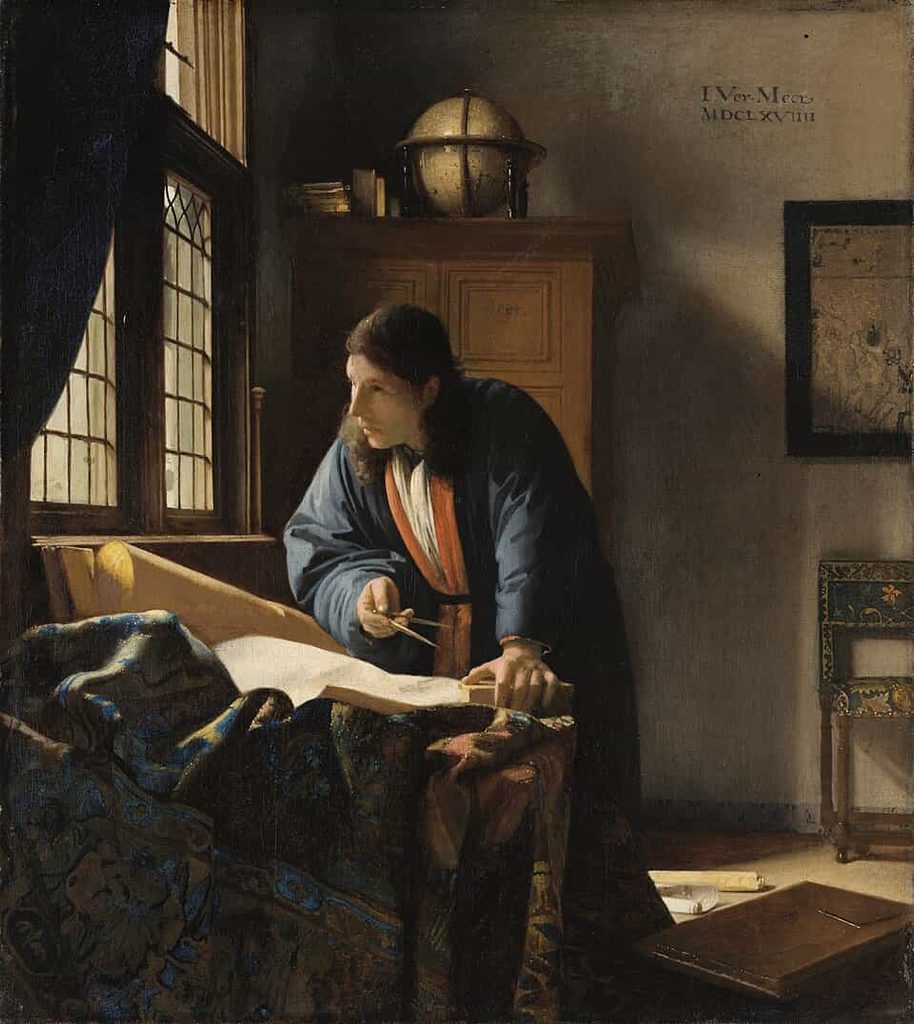
Maps, Paintings and Objects
Vermeer’s interiors contain carefully selected objects.
Maps appear on walls.
Paintings appear within paintings.
Chairs create barriers.
Curtains partially conceal rooms.
Tables divide the viewer from the figure.
These objects help construct the composition.
A chair is not merely furniture.
It can stop our eye.
A curtain can create depth.
A map can create a large rectangular shape across a pale wall.
A painting within the painting can introduce another image and another possible layer of meaning.
Vermeer seems to ask a simple question repeatedly:
How much does the picture actually need?
Johannes Vermeer and Perspective
One reason Vermeer’s rooms feel convincing is his use of linear perspective.
Lines created by tables, tiled floors, windows and furniture guide the eye into space.
Research has revealed pinholes at vanishing points in some paintings.
One particularly interesting example is The Milkmaid, where the vanishing point helped organise the room around the standing figure.
Perspective is not merely a technical demonstration in Vermeer’s work.
He uses it to control where we stand.
The viewer occupies an implied position in front of the scene.
This creates another part of the strange intimacy of his paintings.
We are not looking at an abstract arrangement.
We feel as if we are standing in a real room.
Did Johannes Vermeer Use a Camera Obscura?
This is one of the most frequently asked questions about Johannes Vermeer.
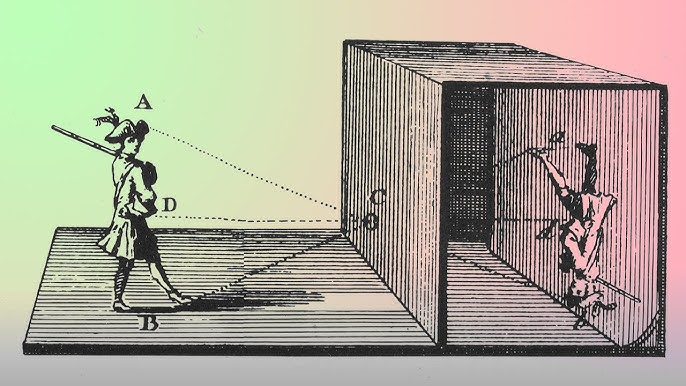
A camera obscura is an optical device that projects an image of the outside world onto a surface through a small opening or lens.
Some historians have proposed that Vermeer may have been familiar with such optical devices.
Certain effects in his paintings have encouraged this idea.
Highlights can resemble circles of light.
Some areas appear sharply focused while others soften.
His understanding of perspective is remarkable.
However, there is no surviving evidence proving that Vermeer used a camera obscura to make his paintings.
This distinction matters.
It is reasonable to discuss optical influence.
It is not reasonable to claim that a machine explains his ability.
Even if Vermeer experimented with optical devices, his paintings required composition, judgement, colour decisions, drawing, revision and extraordinary control of paint.
A projected image cannot make those decisions for an artist.
How Did Johannes Vermeer Paint?
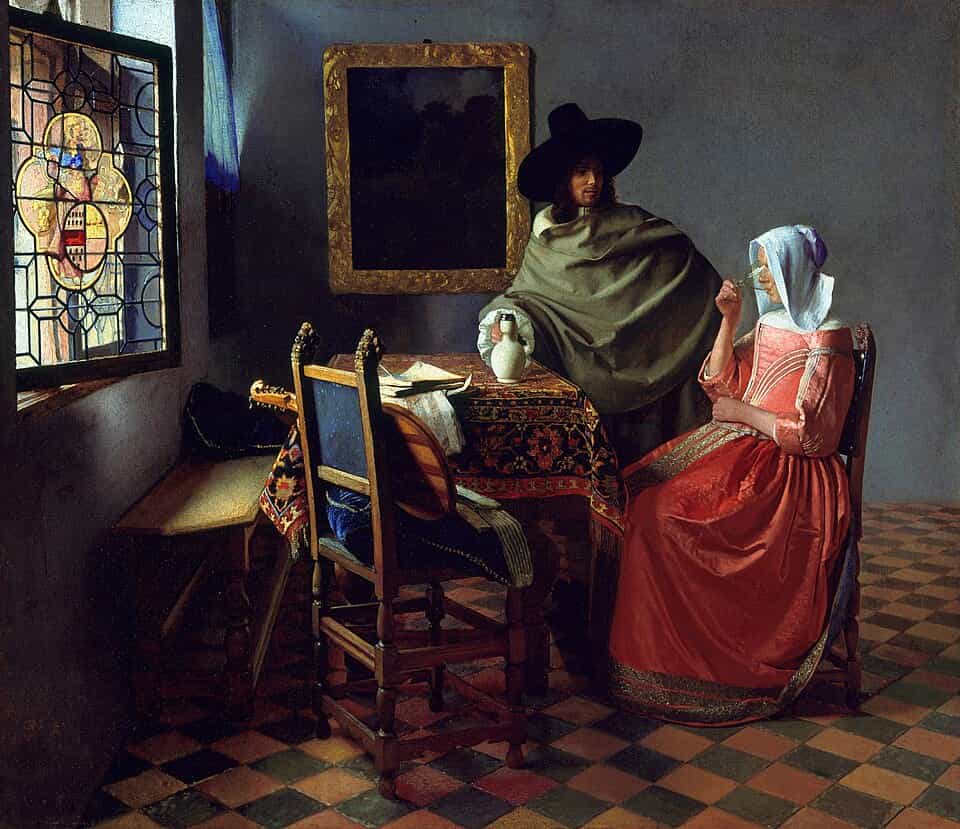
One of the myths around Vermeer is that his paintings arrived through a mysterious, almost magical process.
Research has increasingly shown something more interesting.
He planned.
He adjusted.
He changed his mind.
He painted over objects.
He simplified compositions.
Technical examination has revealed underlying stages and alterations that are difficult to see in the finished paintings.
This makes Vermeer feel less like an untouchable genius and more like a working painter.
He solved visual problems.
A shape was too distracting, so it disappeared.
A wall needed more space.
A figure needed greater emphasis.
A tonal relationship needed changing.
The extraordinary calm of the finished painting was achieved through work.
Vermeer’s Famous Dots of Light
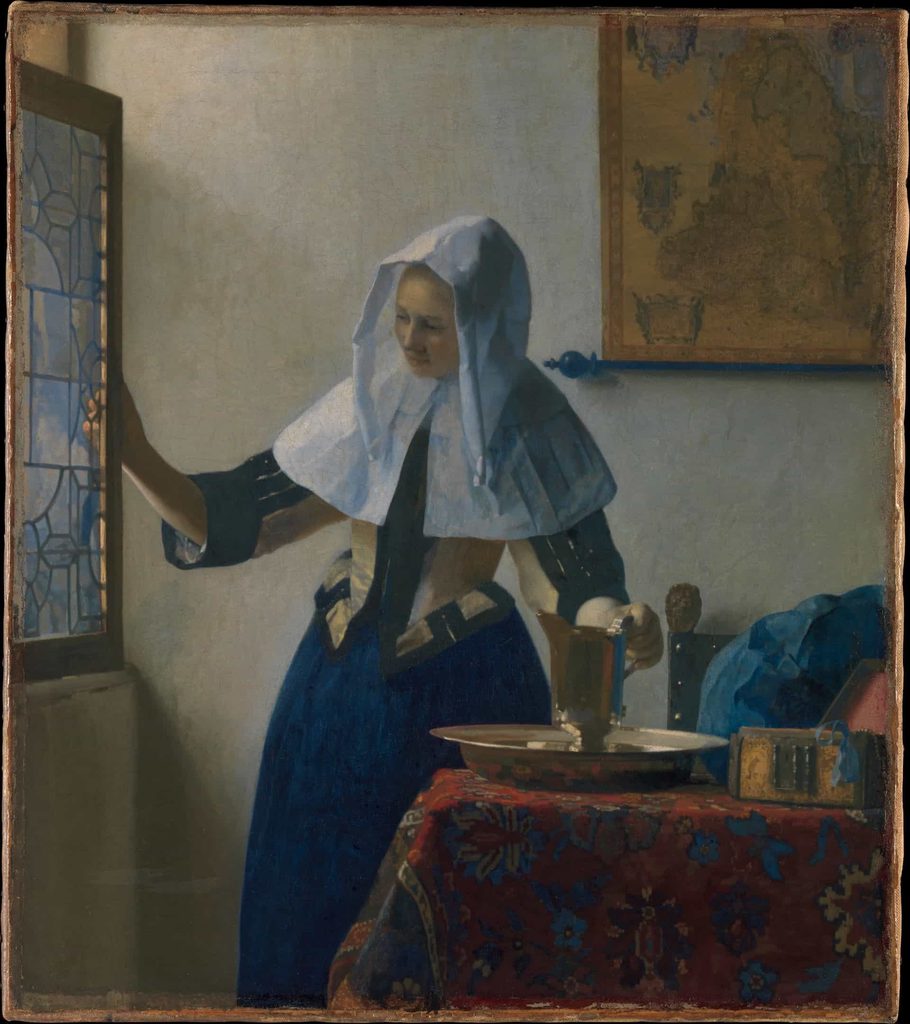
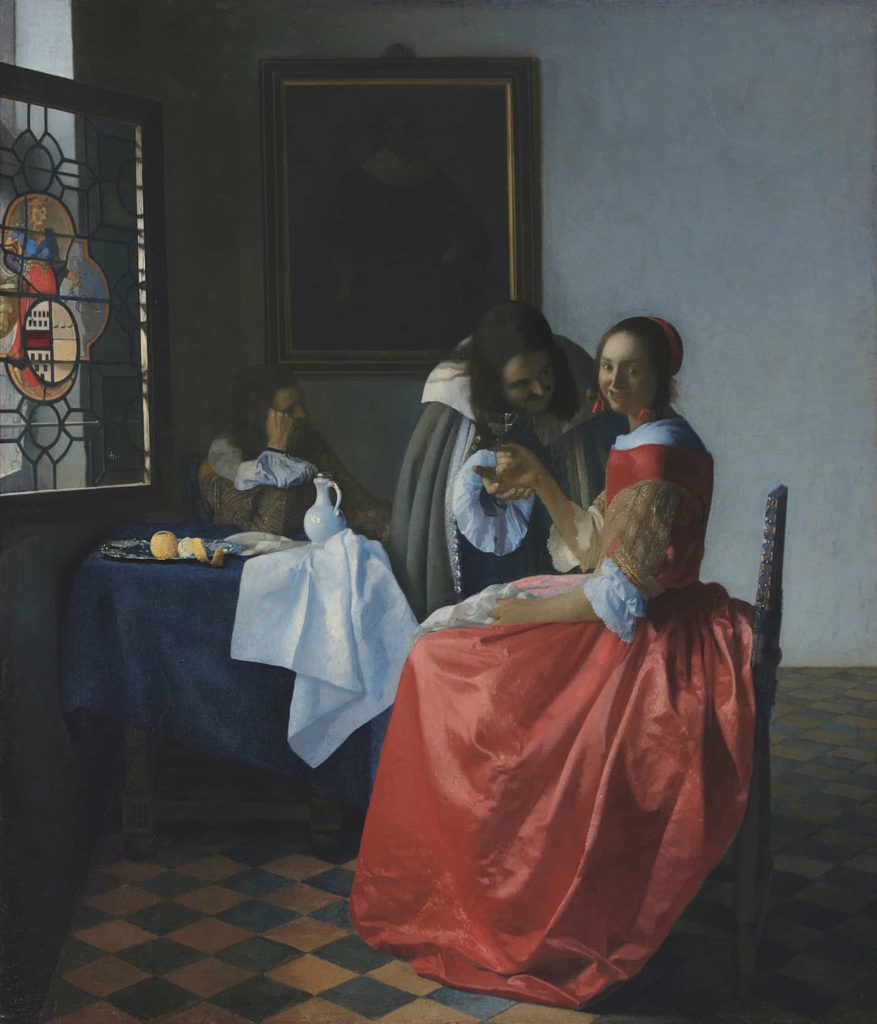
One of Vermeer’s most recognisable techniques is the use of tiny highlights.
These sometimes appear as individual dots or small touches of pale paint.
Bread crusts sparkle.
Metal catches light.
Pearls glow.
Fabric seems luminous.
The marks do not necessarily describe the object literally.
From close range, they can look like paint.
From farther away, the eye interprets them as light.
This is one of the pleasures of seeing a Vermeer in person.
The illusion and the material exist together.
It is a painting of a thing, but it is also visibly made from paint.
Was Johannes Vermeer a Realist Painter?
Vermeer’s paintings certainly appear realistic.
Rooms feel believable.
Light seems natural.
Materials appear convincing.
Yet calling him simply a realist misses something important.
His paintings are highly constructed.
Objects are moved or removed.
Colours are controlled.
Perspective guides us.
Details can be simplified.
Edges may soften.
Compositions are balanced with exceptional precision.
The result looks natural because Vermeer was exceptionally good at hiding the decisions that created it.
His paintings are not neutral recordings of reality.
They are designed realities.

How Many Johannes Vermeer Paintings Exist?
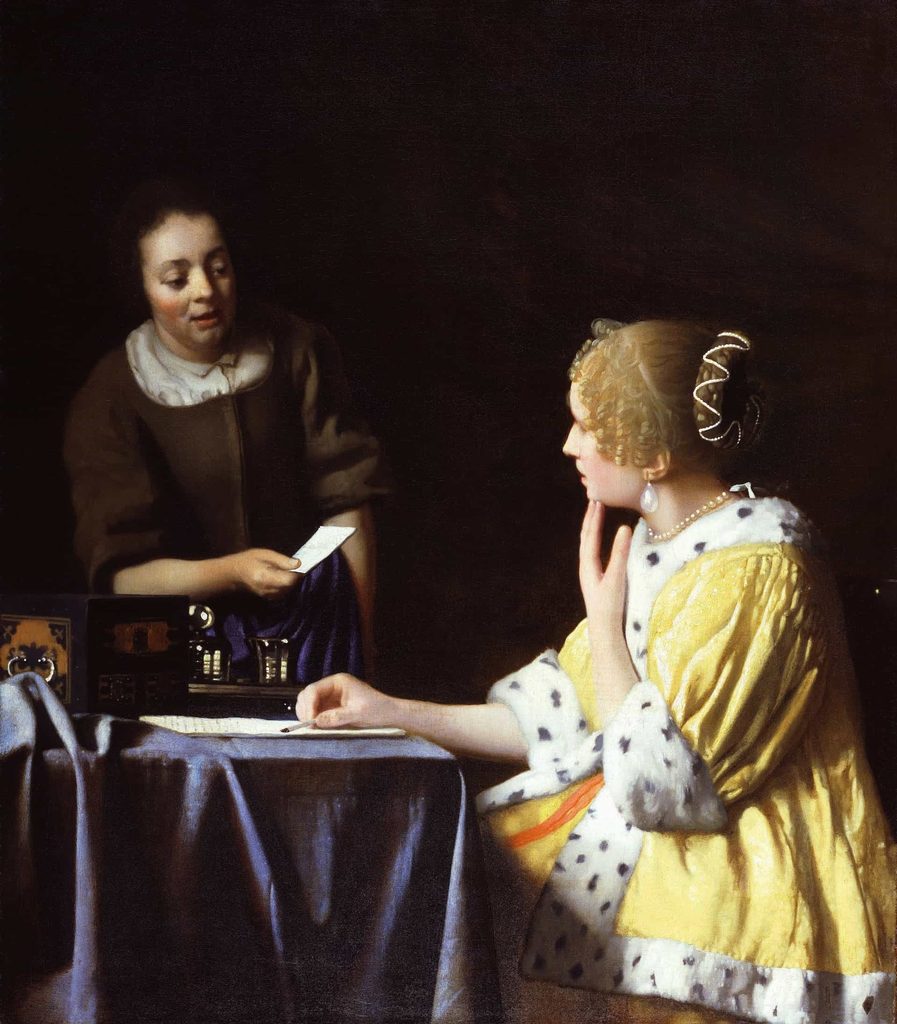
The precise number varies slightly depending on questions of attribution, but only around 35 to 37 paintings are generally associated with Vermeer today.
That is an extraordinarily small body of work for such a famous artist.
Compare this with artists who produced hundreds or thousands of surviving works.
Vermeer’s limited output adds to his fascination.
It also reflects his method.
He appears to have painted slowly and carefully.
His paintings were valuable during his lifetime, and at least one important Delft collector, Pieter Claesz van Ruijven, seems to have owned a substantial portion of his output.
The scarcity of Vermeer paintings means that encountering one in a museum remains unusual.
Why Did Vermeer Paint So Few Paintings?
There is no single confirmed explanation.
Part of the answer may simply be that he worked slowly.
His technique required considerable attention.
He also had other responsibilities.
Vermeer dealt in art, had a large family and held positions within the artists’ guild.
It is also possible that paintings have been lost.
What survives may not represent everything he produced.
Still, the small surviving catalogue has become part of the Vermeer story.
Almost every accepted painting is studied intensely.
Was Vermeer Famous During His Lifetime?
Vermeer was respected in Delft.
His election as head of the Guild of Saint Luke indicates professional standing, and his work attracted collectors.
But he was not an international celebrity comparable with the reputation he has today.
After his death, his name gradually slipped into obscurity.
For roughly two centuries, Vermeer occupied a relatively minor place in art history.
His dramatic rise in reputation came much later.

How Johannes Vermeer Was Rediscovered
Vermeer’s modern fame owes much to nineteenth-century scholarship.
The French critic Théophile Thoré-Bürger became fascinated by his work and helped bring Vermeer back to wider attention.
At that point, establishing which paintings were actually by Vermeer became complicated.
Works had been attributed to other artists.
Other paintings were incorrectly given to Vermeer.
Over time, scholarship refined his accepted body of work.
This rediscovery helped create the modern image of Vermeer as mysterious.
He became known as the “Sphinx of Delft”, an artist whose paintings were famous while much of his biography remained obscure.
Vermeer and Forgery
The scarcity and desirability of Vermeer paintings eventually created another chapter in his history: forgery.
The most notorious case involved the Dutch painter Han van Meegeren in the twentieth century.
Van Meegeren produced paintings intended to look like previously unknown Vermeer works.
Some fooled respected experts.
The story became particularly dramatic after the Second World War when Van Meegeren was accused of collaborating with the enemy by selling a supposedly important Dutch artwork to Nazi leader Hermann Göring.
To defend himself, he claimed the painting was not a Vermeer at all.
He had painted it himself.
The episode remains one of the most extraordinary forgery stories in art history and demonstrates how powerful Vermeer’s reputation had become.
Famous Johannes Vermeer Paintings
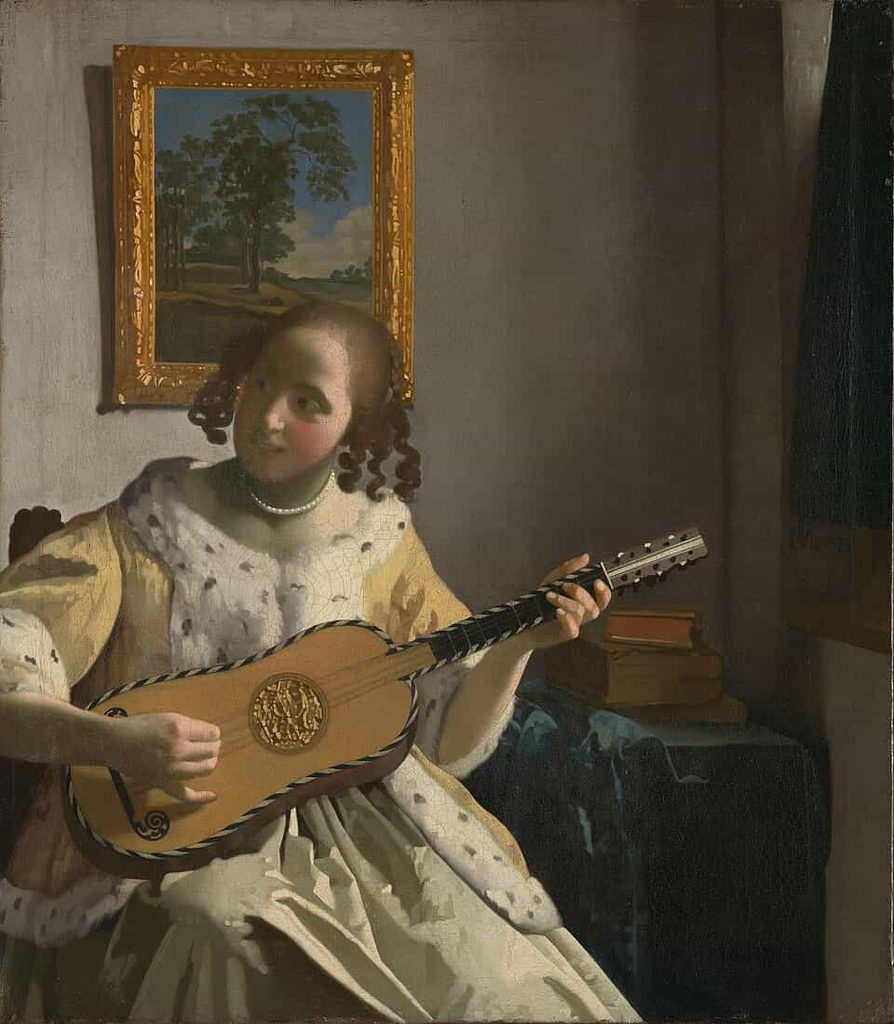
For anyone beginning to explore Johannes Vermeer, these works provide an excellent starting point:
Girl with a Pearl Earring
The Milkmaid
View of Delft
The Little Street
Woman Reading a Letter
Woman Holding a Balance
The Art of Painting
The Lacemaker
The Astronomer
The Geographer
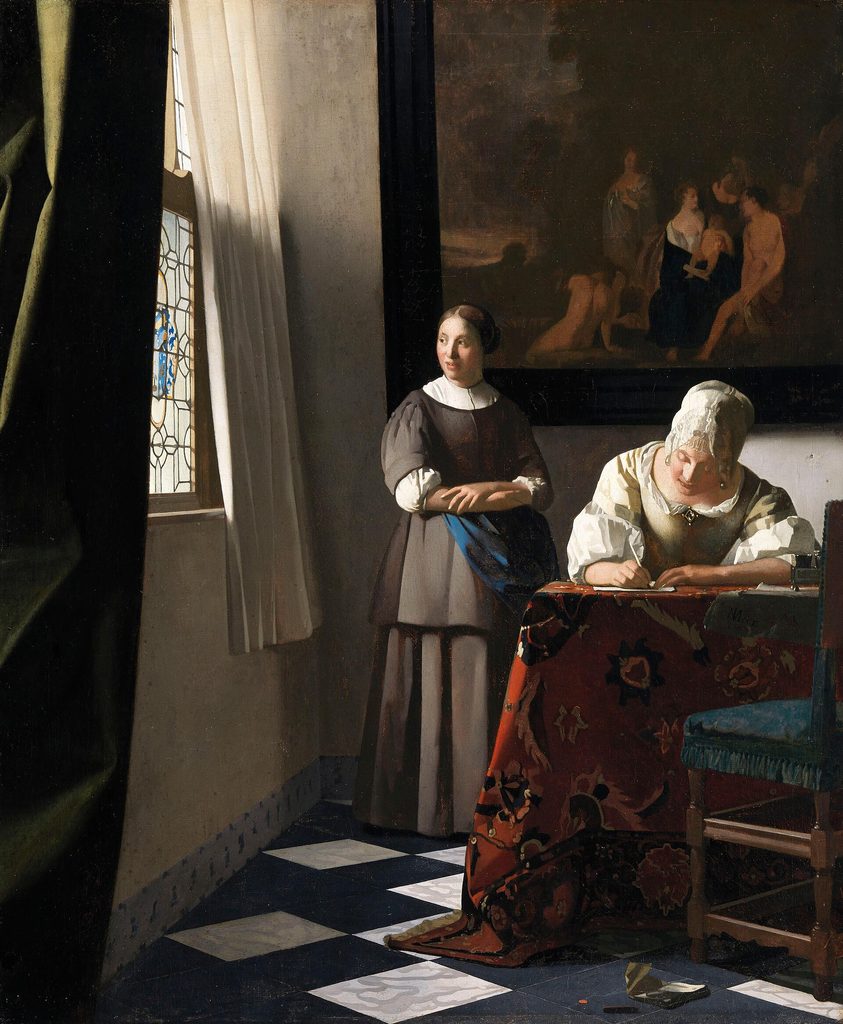
A Lady Writing
The Music Lesson
The Love Letter
Woman with a Pearl Necklace
A Young Woman Standing at a Virginal
A Young Woman Seated at a Virginal
Together they reveal just how much variation Vermeer created within a relatively narrow range of subjects.
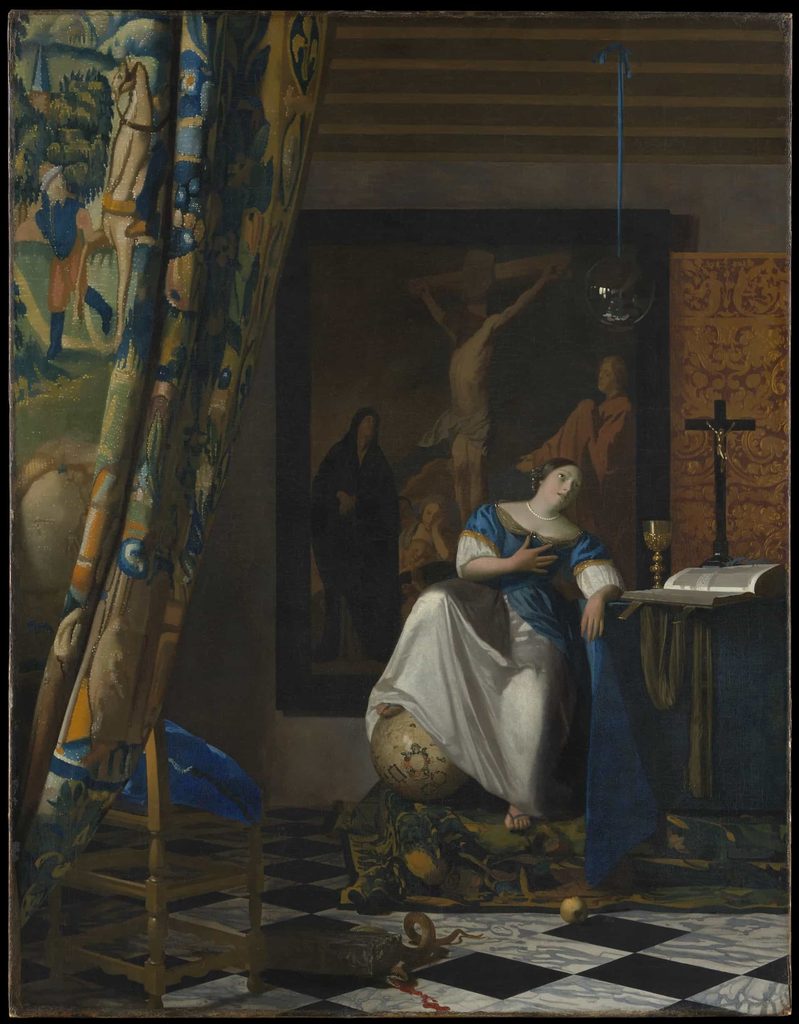
The Art of Painting
The Art of Painting is one of Vermeer’s most ambitious works.
It shows an artist from behind, painting a young woman in a studio.
A curtain has been pulled aside, making us feel as though we have entered the room.
A large map dominates the wall.
The tiled floor creates deep perspective.
The model wears symbolic attributes.
It is both an interior scene and a painting about painting itself.
Who is the artist?
What is being represented?
What does the map mean?
Is this an ideal image of the painter’s profession?
Vermeer does not give us easy answers.
The painting turns the quiet domestic interior into a meditation on art, history and representation.
The Lacemaker
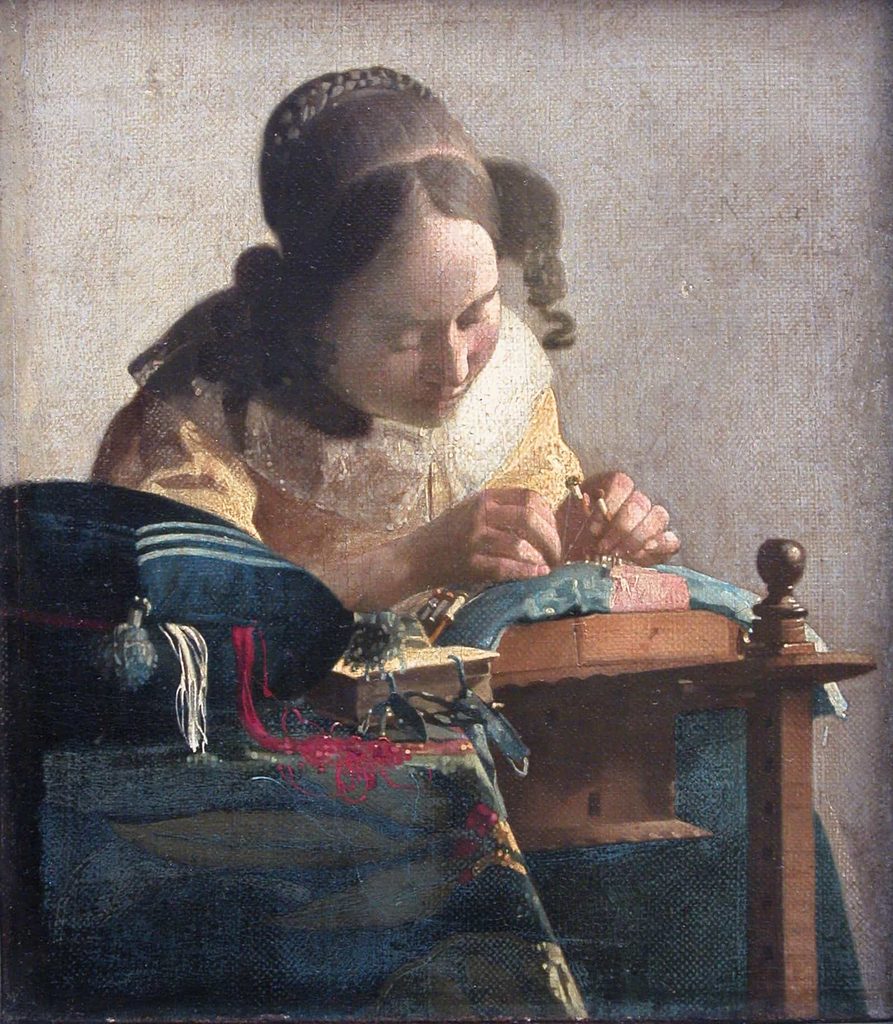
The Lacemaker is one of Vermeer’s smallest paintings.
A young woman bends over her work.
Her attention is absolute.
Threads and tools occupy the foreground.
Some details become surprisingly loose.
A red and white tangle of thread almost dissolves into paint.
Again, Vermeer takes a minor domestic activity and gives it complete seriousness.
There is no need for spectacle.
Concentration itself becomes the subject.
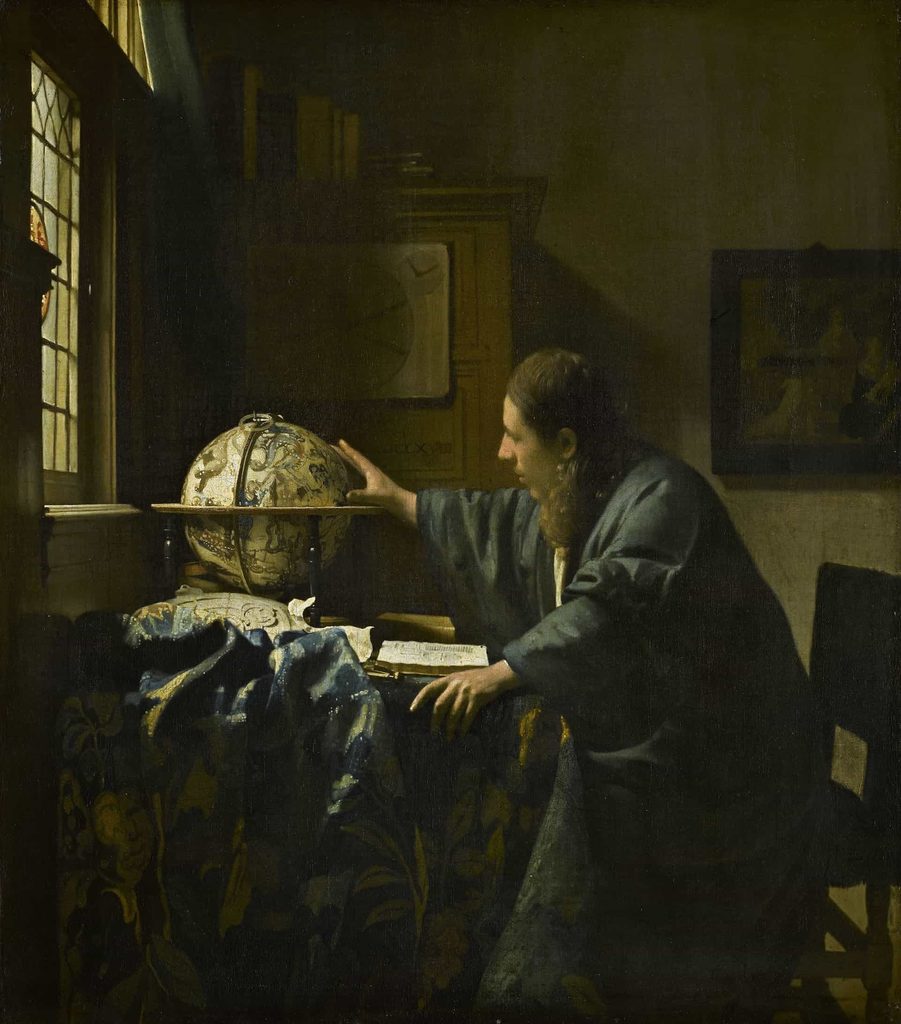
The Astronomer and The Geographer
Not all Vermeer’s interior figures are women.
The Astronomer and The Geographer show male scholars working within interior spaces filled with scientific and geographical objects.
These paintings connect Vermeer with the intellectual culture of the Dutch Republic.
Maps, globes, books and instruments suggest curiosity about the wider world.
The figures are active thinkers.
They lean, reach and examine.
Light again enters the space and gives physical presence to the act of thought.
Why Do Vermeer Paintings Feel So Quiet?
It is tempting to say that Vermeer’s subjects are simply quiet.
That is only part of the explanation.
The silence is constructed.
There are usually few figures.
Movement is limited.
Large areas of wall create visual breathing room.
Objects are arranged carefully.
Lighting is soft.
Expressions are restrained.
Strong diagonals and dramatic gestures are often avoided.
Vermeer also chooses moments in which something has slowed.
Reading.
Pouring.
Thinking.
Playing.
Looking.
Waiting.
These moments give the viewer time.
Many paintings tell us to look.
Vermeer’s paintings seem to ask us to look longer.
Why Johannes Vermeer Still Feels Modern
Vermeer’s paintings were made more than 350 years ago, yet many feel surprisingly contemporary.
Part of this comes from their simplicity.
His interiors are uncluttered.
Compositions are clear.
Colour is controlled.
Figures are often caught in private moments.
There is also something photographic about his framing.
A figure may be partially blocked by furniture.
A curtain enters the foreground.
An object is cropped.
Focus seems to change.
These qualities feel familiar to eyes accustomed to photography and cinema.
Yet Vermeer was painting before either existed.
His interest in everyday life also feels modern.
He understood that ordinary moments can carry enormous visual and emotional weight.
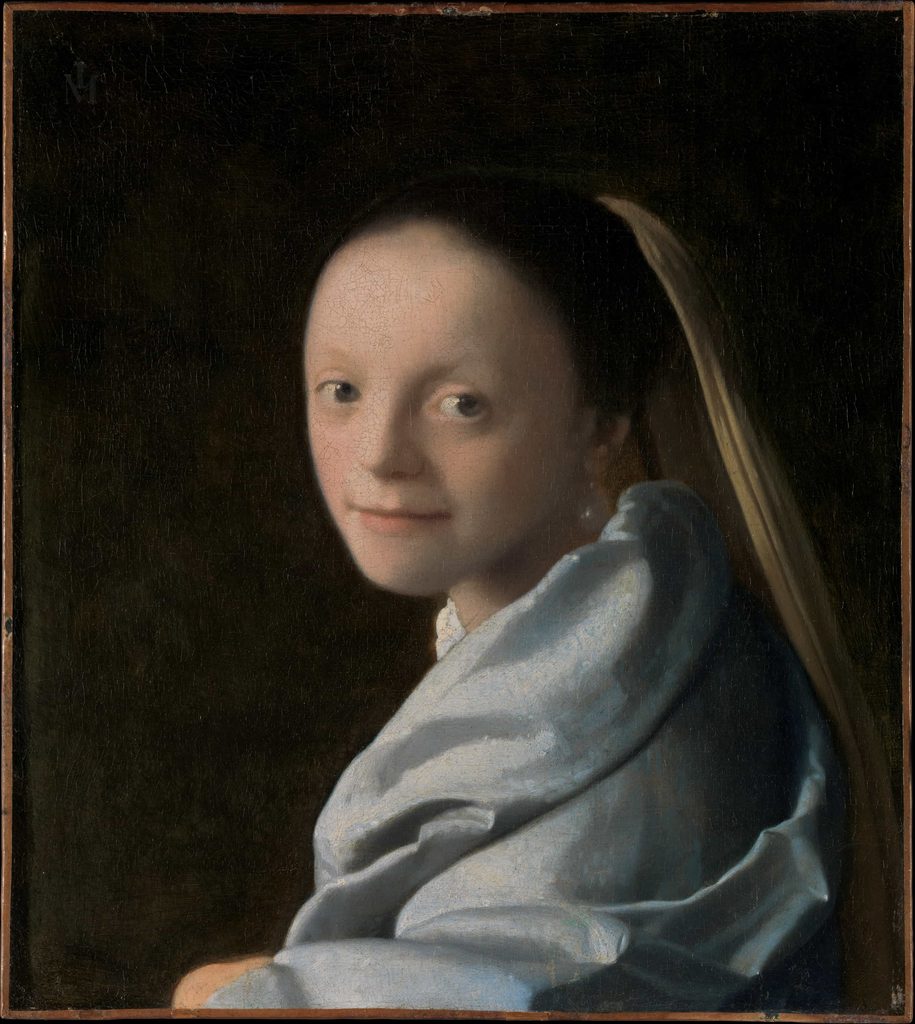
What Artists Can Learn from Johannes Vermeer
Artists do not need to paint like Vermeer to learn from him.
His work offers broader lessons.
Pay attention to light.
Simplify when necessary.
Do not fill every space.
Allow quiet areas to exist.
Use colour relationships rather than isolated colours.
Consider where the viewer is standing.
Let objects contribute to composition.
Remove details that weaken the main idea.
Observe ordinary life carefully.
Give small subjects serious attention.
Perhaps most importantly, Vermeer demonstrates that visual impact does not depend on noise.
A painting can whisper and still hold a room.
What Photographers Can Learn from Vermeer
Vermeer is also frequently admired by photographers and cinematographers.
His paintings offer lessons in:
Window light
Framing
Negative space
Colour temperature
Depth
Foreground objects
Directional light
Human gesture
Visual storytelling
A single figure near a window can create enough visual structure for an entire image.
Vermeer’s work demonstrates how carefully controlled light can create atmosphere without obvious theatrical effects.
What Can We Learn from Vermeer About Composition?
One of Vermeer’s great strengths is his ability to direct attention without making the composition feel forced.
He uses:
Windows
Tables
Chairs
Curtains
Maps
Tiled floors
Frames
Figures
Light
Empty walls
These elements create pathways for the eye.
A chair may create distance between us and the figure.
A curtain may make us feel like observers entering a private scene.
A tiled floor can establish perspective.
A bright piece of clothing can pull the eye towards the central figure.
The composition seems natural only because the organisation is so effective.
Seeing a Vermeer in Person
Reproductions cannot fully communicate what happens in front of an original Vermeer.
The paintings are often smaller than people expect.
That scale matters.
You have to approach them.
Details reveal themselves slowly.
The surface contains moments that disappear in photographs.
Tiny highlights become separate marks.
Blue appears inside shadow.
Soft edges sit beside sharp ones.
Thin passages meet thicker touches of paint.
The apparent realism begins to break apart.
Then you move back.
The room returns.
This movement between paint and illusion is one of the great pleasures of looking at Vermeer.
Johannes Vermeer FAQs
Who was Johannes Vermeer?
Johannes Vermeer was a Dutch painter born in Delft in 1632. He is best known for carefully composed domestic interior scenes, his treatment of natural light and paintings including Girl with a Pearl Earring, The Milkmaid and View of Delft.
What is Johannes Vermeer famous for?
Johannes Vermeer is famous for quiet interior scenes, luminous natural light, carefully balanced compositions, rich colour and intimate depictions of everyday life.
What is Johannes Vermeer’s most famous painting?
Girl with a Pearl Earring is probably Vermeer’s most recognisable painting today. The Milkmaid and View of Delft are also among his best-known works.
Is Girl with a Pearl Earring a portrait?
It is generally classified as a tronie rather than a conventional portrait. A tronie represented a type, expression or character rather than primarily documenting a named sitter.
How many Vermeer paintings are there?
Only around three dozen paintings are generally accepted as works by Johannes Vermeer. The exact number varies slightly according to attribution.
Why did Vermeer paint so few paintings?
Vermeer appears to have worked slowly and carefully. He also worked as an art dealer, had a large family and held responsibilities within Delft’s painters’ guild. Some paintings may also have been lost.
Where was Johannes Vermeer born?
Johannes Vermeer was born in Delft in the Dutch Republic in 1632. He lived and worked there throughout his life.
When did Johannes Vermeer die?
Vermeer died in Delft in December 1675 at the age of 43.
Did Vermeer use a camera obscura?
It has been suggested that Vermeer may have known about or experimented with a camera obscura because of optical effects visible in his paintings. There is, however, no documentary evidence proving that he used one.
What colours did Vermeer use?
Vermeer is particularly associated with blue and yellow. He famously used expensive natural ultramarine made from lapis lazuli, sometimes using the pigment in surprisingly subtle areas such as shadows.
Why are there so many women in Vermeer’s paintings?
Women were common subjects in seventeenth-century Dutch domestic genre painting. Vermeer repeatedly used women reading, making music, working or standing in interiors to create quiet scenes of concentration, intimacy and possible narrative.
Was Vermeer famous when he was alive?
Vermeer was respected in Delft and served as head of the Guild of Saint Luke, but his reputation was largely regional. His international fame developed much later, particularly after his rediscovery by nineteenth-century art historians and critics.
What art movement was Johannes Vermeer part of?
Vermeer is associated with seventeenth-century Dutch painting and the Dutch Golden Age. His mature work belongs especially to the tradition of Dutch genre painting.
What makes Vermeer’s paintings different?
Vermeer combines observation with careful construction. Light, perspective, colour, objects, empty space and human gestures are arranged with unusual precision, creating scenes that appear natural while being highly controlled.
Final Thoughts
Johannes Vermeer did not need grand subjects to make great paintings.
A jug of milk was enough.
A letter was enough.
A window was enough.
A young woman making lace was enough.
What mattered was attention.
Vermeer looked closely at how daylight crossed a room, how blue changed inside shadow, how fabric caught a highlight, how a figure occupied space and how an ordinary moment could become strangely important when everything around it was carefully controlled.
That is why his paintings remain powerful.
We live in a world overflowing with images. Thousands can pass in front of us during a single day.
Vermeer asks for the opposite.
One room.
One figure.
One moment.
Look again.
Then look a little longer.
More than three centuries after his death, that quiet invitation may be one of the reasons Johannes Vermeer still feels so relevant.
Leave a Reply