
No products in the cart.
Top Artist of History: Andy Warhol: King of Pop Art
Andy Warhol remains one of the few artists whose work is recognised even by people who do not usually follow art history. A stack of soup cans, a repeated image of Marilyn Monroe, a bright portrait in unnatural colour, a row of Coca-Cola bottles, these images have moved so fully into public consciousness that they can feel almost inevitable. Yet that familiarity is exactly why Warhol still matters. He understood, earlier and more clearly than most, that modern life was becoming an endless stream of repeated images, branded objects, celebrity faces and manufactured desire.
That is why writing about Warhol today still feels worthwhile. He was not simply a famous Pop artist who made bold and colourful prints. He changed what art could take as its subject, how it could be made, and how artists could position themselves within media culture. He blurred boundaries between art and advertising, originality and repetition, glamour and emptiness, fascination and critique. Long before image saturation became a phrase people used about social media and online life, Warhol was already showing what it looked like to live in a world where surfaces, symbols and fame were being mass produced.
For readers searching for Andy Warhol, who Andy Warhol was, why Warhol matters, famous Andy Warhol paintings, Pop Art explained, Marilyn Diptych, Campbell’s Soup Cans, Warhol prints, Warhol and celebrity, or Warhol and consumer culture, the real question is often larger than biography. Why did this artist become such a defining figure of modern art? Why do his works still feel instantly legible, while also remaining open to new readings? And why does so much contemporary art, design, fashion, photography and visual culture still seem to echo his way of seeing?
This guide looks at Warhol’s life, his major works, his role in Pop Art, his fascination with fame and consumption, and the reasons he still feels urgent now. The aim is to move beyond the simplified image of Warhol as a cool, detached maker of celebrity pictures and show why his art continues to matter within both history and the present.

Who was Andy Warhol?
Andy Warhol was born Andrew Warhola in Pittsburgh in 1928 and went on to become one of the leading figures of American Pop Art in the 1960s. Before he became famous in galleries, he worked as a highly successful commercial illustrator in New York. That early career matters because it shaped how he thought about images from the start. He was already fluent in advertising, magazine culture, layout, style and visual repetition before he moved into the art world.
This background helps explain a lot. Warhol did not arrive in fine art as someone trying to escape commercial imagery. He arrived as someone who understood it from the inside. He knew how desire could be built visually, how products could become icons, and how a face could function like a brand. Rather than rejecting that world, he absorbed it and used it as his material.
By the early 1960s, Warhol had begun making paintings based on everyday consumer goods such as Campbell’s soup cans and Coca-Cola bottles, as well as publicity stills and press images of celebrities. These works quickly made him central to Pop Art, a movement that drew on images from advertising, television, comics, film and popular culture.
But Warhol did more than simply bring ordinary objects into art. He developed a whole visual language around repetition, flatness, silkscreen printing and serial display. His work often looked mechanical even when it was carefully made. That was part of the point. Warhol understood that modern culture was already repeating the same images until they became both seductive and strangely empty.

Why Warhol became the face of Pop Art
Warhol is often described as the king of Pop Art because he brought together so many of the movement’s central concerns in an unusually sharp and memorable way. Pop Art emerged in the 1950s and 1960s and drew on the look of mass media and consumer goods. Instead of treating advertisements, comic strips, celebrities and supermarket products as beneath serious art, Pop artists turned them into major subjects.
Warhol did this with particular force because he chose images that were already deeply embedded in public life. Everyone knew the Campbell’s label. Everyone recognised Coke. Everyone knew Marilyn Monroe’s face. These were not obscure cultural references. They were mass images. By using them in painting and print, Warhol brought the language of commerce directly into the gallery.
What made his approach distinctive was his refusal to separate critique from attraction. His images are neither simple celebrations of consumer culture nor straightforward attacks on it. They sit in a more uncomfortable place. They are glossy and repetitive, seductive and blunt, playful and deadpan. They capture the strange fact that mass culture can be both democratic and numbing, desirable and disposable, intimate and impersonal.
This is one reason Warhol still feels so contemporary. We are now even more surrounded by repeated images, branded identities and visual noise than people were in the early 1960s. Warhol looks prophetic because he saw where culture was heading and turned that shift into form.


Campbell’s Soup Cans and the shock of the ordinary
Few works have changed the course of modern art as clearly as Campbell’s Soup Cans. First exhibited in 1962, the work consists of thirty two canvases, each representing a different variety of soup. Warhol displayed them together in a way that echoed supermarket shelving.
At one level, the work looks almost absurdly simple. It is a soup can, repeated. Yet that repetition changes everything. Once the can enters the gallery, it stops being only a product and becomes a question. What makes one image worthy of serious attention and another ordinary? What happens when advertising design enters fine art? What does repetition do to value, originality and aura?
The work is also important because it marks a shift in subject matter. Earlier modern movements often used abstraction, myth, private symbolism or formal experiment to break from tradition. Warhol does something different. He turns directly towards banality. He chooses something so familiar and widely consumed that it might almost disappear from notice. Then he insists on looking at it again.
This move remains one of the keys to Warhol’s art. He made people see what they thought was too ordinary to matter. But in doing so, he also showed how deeply ordinary images structure daily life.

Marilyn Monroe, celebrity and repetition
If Campbell’s Soup Cans established Warhol’s interest in consumer culture, Marilyn Diptych and the later Marilyn works made his engagement with fame unmistakable. Monroe had died in 1962, and Warhol used a publicity image from the film Niagara as the basis for one of his most iconic bodies of work.
What makes these works so powerful is not only the image itself, but how Warhol handles it. Monroe’s face is repeated again and again, sometimes brightly coloured, sometimes fading, sometimes misregistered, sometimes ghostly. The result is not a simple portrait. It is a meditation on how celebrity operates in modern culture.
The repeated face becomes both unforgettable and strangely emptied out. Monroe appears glamorous, but also consumed. The more the image repeats, the more it starts to lose a sense of living individuality. It becomes a product, an icon, a memorial and a mask all at once.
This tension is one reason the Marilyn works still feel haunting. They show the violence hidden inside the making of a public image. Fame promises immortality through repetition, but repetition can also flatten a person into surface. Warhol understood that celebrity culture creates intimacy at a distance. People feel they know the face, but what they know is the image, endlessly reproduced.
Long before influencer culture, algorithmic fame and the constant circulation of public personas, Warhol had already grasped the logic of celebrity as image production.
Warhol and the screenprint
Warhol’s use of silkscreen printing was central to his impact. Earlier artists had used printmaking in many forms, but Warhol made silkscreen into a signature method for fine art in the age of mass reproduction. This mattered because the technique allowed him to repeat images while retaining slight differences, misalignments and variations.
That tension between sameness and difference is one of the keys to his work. A repeated image is never quite identical. Colours shift. Edges slip. Ink behaves unpredictably. Mechanical process and human accident collide.
Warhol’s use of silkscreen also changed how viewers thought about originality. Instead of treating the single handcrafted image as the highest form of artistic value, he embraced repeatability. In doing so, he asked whether an art object still needed to feel unique in order to matter.
This was not a neutral technical decision. It was directly tied to his subject matter. Products, celebrities and news photographs already circulated through mass reproduction. Silkscreen printing allowed Warhol’s artworks to mimic that circulation rather than pretending to stand outside it.
The Factory and the making of an artist persona
Warhol was not only important because of the artworks he made. He was also important because of the way he staged artistic identity. His New York studio, known as The Factory, became one of the defining cultural spaces of the 1960s. It was part studio, part social scene, part film set, part music venue, part myth making machine.
At The Factory, Warhol worked with assistants, collaborators, musicians, actors, writers and downtown figures from different scenes. This was significant in itself. It pushed against the older romantic idea of the artist as a solitary genius working alone in the studio. Warhol’s practice was often collective, mediated and theatrical.
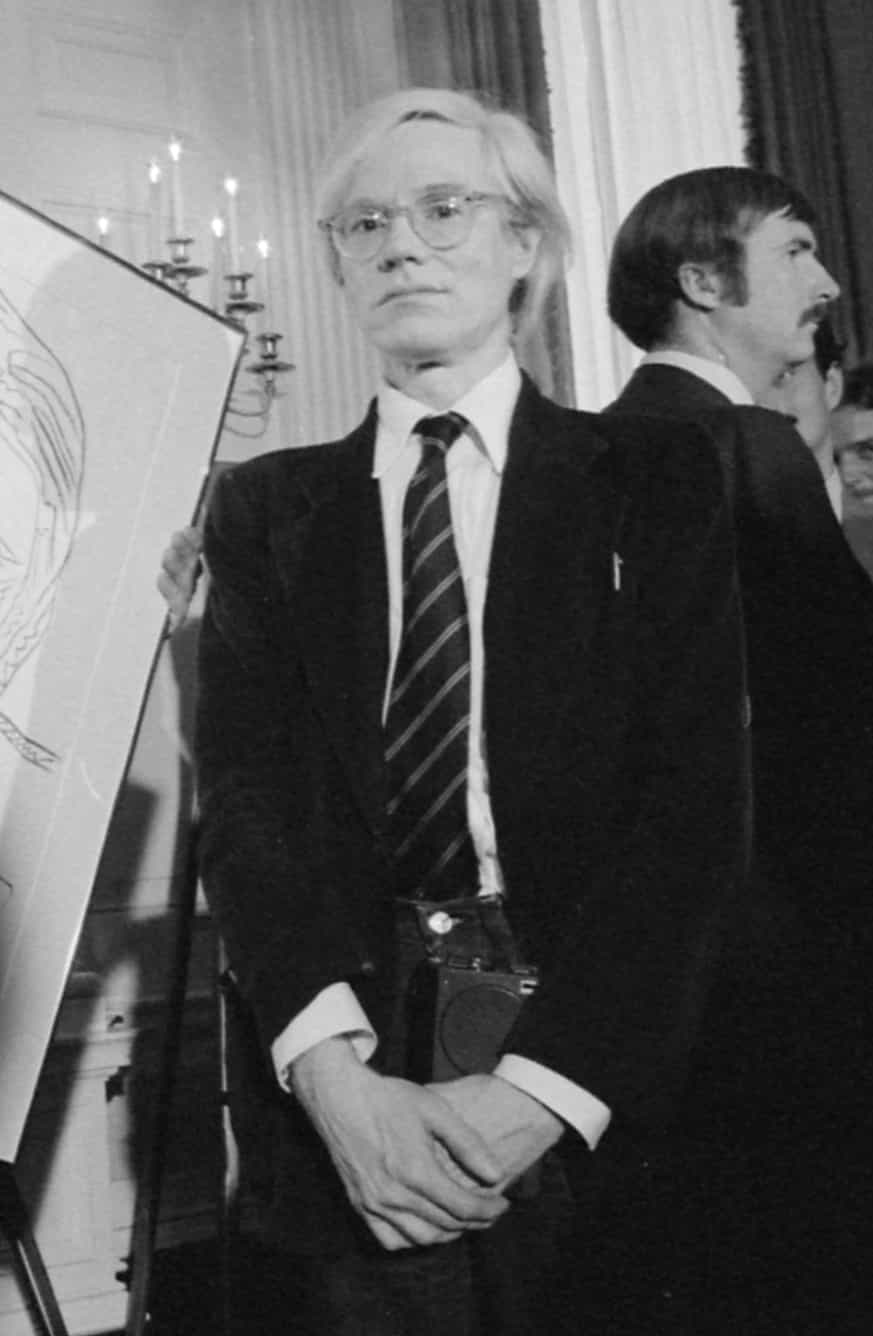
He also cultivated a public persona that felt curiously blank and highly memorable at the same time. The silver wigs, dark glasses, flat voice and dry comments all became part of his image. This was not separate from the art. Warhol understood that in a media saturated culture, the artist could become a brand too.
That insight still matters. Many contemporary artists work in a cultural environment where self presentation, publicity and image circulation are part of artistic life. Warhol did not invent that condition entirely, but he saw it clearly and used it with unusual intelligence.

Andy Warhol – Marilyn Diptych 1962 – © Andy Warhol Photo by Daniel Rabinovich, website https://rabinovichgallery.com/
Warhol and the darker side of Pop
Warhol is often reduced to the bright surface of Pop Art, but that leaves out some of his most powerful work. Alongside celebrity portraits and consumer goods, he made images from car crashes, race riots, electric chairs and newspaper reports of disaster. These works are essential because they reveal that Warhol’s vision of modern culture was not simply playful or celebratory.
In the Death and Disaster series, repetition takes on a different force. Instead of a soup can or a star, the repeated image may show wreckage, death or public trauma. The effect is disturbing. Repetition does not make the image easier to bear. It reveals how mass media processes horror, circulating it until shock becomes part of the everyday visual field.
This is one of the reasons Warhol’s work remains so relevant. He understood that media culture does not only manufacture desire. It also manufactures numbness. The same systems that turn products and celebrities into icons can also turn suffering into repeated imagery.
This darker side of Warhol is crucial if you want to understand why he was more than a chronicler of bright surfaces. He knew those surfaces were unstable. They could charm, but they could also anaesthetise.

Consumption, class and the myth of democracy
One of Warhol’s most quoted ideas is that a Coke is a Coke, and no amount of money can get you a better Coke than the one the ordinary person drinks. This line has often been taken as evidence that Warhol saw consumer culture as democratic. On one level, that reading makes sense. Mass produced goods flatten difference. Everyone recognises the same bottle, the same label, the same star.
But the situation is more complicated than that. Warhol understood the seductive myth of democratic consumption, but his art also exposes how shallow that equality can be. The fact that everyone sees the same image does not mean everyone has equal power, safety or visibility. The same culture that distributes products widely also distributes status unevenly.
That tension sits at the heart of his work. Pop Art can look democratic because it uses familiar imagery, but familiarity does not necessarily mean liberation. Warhol’s art remains interesting because it never fully resolves this tension. He captures the appeal of the mass image while also showing how repetition, branding and visibility reshape life in unsettling ways.


Why Warhol still matters in the age of social media
If Warhol once seemed like the artist of television, magazines and supermarket shelves, he now also looks like the artist of feeds, platforms and endlessly circulated images. Much of what he explored has intensified.
Celebrity is now constant rather than occasional. Branding has become personal as well as corporate. Repetition drives visibility. Public identity is built through image management. The line between self expression and self marketing is blurred. Surface matters, but it never feels fully stable.
Warhol’s art anticipated these conditions with remarkable precision. He understood that repetition is not boring in modern culture. It is the mechanism through which value is built. The more an image circulates, the more powerful it can become, and the more detached it may also become from lived reality.
This is why younger viewers often find Warhol easier to understand than some other modern artists. He belongs to an image world that still feels recognisable. His art may have been made decades ago, but its logic still describes the present.
Warhol and fashion, film and music
Warhol’s influence goes far beyond painting and print. He moved across fashion, publishing, experimental film, performance, photography and music. His work with The Velvet Underground, his film projects, his portraits of social figures, and his involvement with magazines all made him more than a studio artist.
This matters because it helps explain why Warhol’s cultural footprint is so large. He did not treat fine art as a sealed category. He moved through different forms of media, often treating them as part of the same larger field of image production.
This also helps explain why designers, photographers, musicians and stylists still look to Warhol. He helped create a model of the artist as a figure who could move across cultural worlds without losing conceptual focus.

The myth and the person
One of the difficulties with Warhol is that the myth can easily overshadow the work. He became so famous, and so good at constructing his public image, that people sometimes treat him more as a symbol than as a serious artist.
But the myth itself is part of the work’s meaning. Warhol did not simply allow celebrity culture to engulf him. He studied it, performed it and turned it back into art. That said, it is still worth remembering that beneath the cool public persona was a complicated individual shaped by religion, immigrant family background, illness, ambition, queerness and vulnerability.
This more human Warhol matters because it makes the work richer. His fascination with beauty, fame, repetition and image can be read not only as social observation but also as a way of handling anxiety, desire, distance and mortality. The glamorous surfaces are real, but so are the pressures underneath them.
Why Warhol remains a key figure in art history
Warhol remains central because he changed both subject matter and method. He showed that products, publicity stills, tabloid photographs and repeated media images could become serious art. He helped transform the relationship between fine art and mass culture. He made repetition conceptually powerful. He treated celebrity as a modern condition rather than a side issue. He understood that images were no longer isolated. They were circulating, multiplying and shaping public life.
He also remains important because he changed the role of the artist. Warhol did not simply make art objects. He staged a way of being an artist in a media age. He understood the relationship between image, persona, publicity and value better than almost anyone of his generation.
That is why so many contemporary artists still work in his shadow, whether they are embracing or resisting it. Questions about appropriation, branding, fame, repetition, mechanical process and visual culture are all part of the territory Warhol helped define.
Andy Warhol became the king of Pop Art not just because he made famous images, but because he understood the deeper logic of the world those images came from. He recognised that modern life was increasingly organised through repetition, celebrity, products and media surfaces, and he turned that recognition into one of the most influential bodies of work in modern art.
What makes Warhol endure is that he never fully tells us how to read him. His work can feel glamorous and empty, comic and disturbing, seductive and cold, critical and complicit, all at once. That ambiguity is not a weakness. It is one of the reasons the art keeps working.
The soup cans still matter because consumer culture still shapes everyday life. Marilyn still matters because celebrity still consumes and circulates the human face. The disasters still matter because media still repeats trauma until it becomes part of public routine. Warhol still matters because the world he saw has only become more intense.
To look at Warhol now is not simply to revisit a chapter of 1960s Pop Art. It is to look at an artist who grasped, with unusual clarity, how images were beginning to govern modern experience. That is why his work still feels immediate. It belongs to history, but it also belongs to the present.
Leave a Reply