
No products in the cart.

Sussex In Paint: Landscape, Coast And Skylines In Contemporary British Art
Sussex has long held a special place in British art. Its chalk cliffs, open sea, rolling Downs, wooded interior and distinctive coastal towns create a landscape that feels both varied and immediately recognisable. Within a relatively compact area, artists can move from white cliffs and broad seafront light to wooded lanes, estuaries, marshland, flint villages and urban coastal skylines. For contemporary British artists, Sussex offers both subject and structure. It gives them places to observe, but it also gives them visual systems to think with, including horizon lines, chalk contours, weather fronts, tidal edges, sea glare, pier structures and cliff faces.
That combination helps explain why Sussex appears so often in painting, photography, sculpture and mixed media. It is not only beautiful. It is visually rich and emotionally flexible. Sussex can feel calm, exposed, luminous, windblown, historic or sharply modern depending on the season, the weather and the artist’s point of view. It offers broad skies over the Downs, severe coastal light, and towns whose skylines are shaped by piers, pavilions, church towers, fishing infrastructure and modern architecture. That mixture makes Sussex unusually fertile ground for art about place.
For many people searching for Sussex art, Sussex landscape painting, coastal art in Sussex, Brighton art, Seven Sisters in art, South Downs artists or contemporary British landscape art, the deeper question is often the same. What is it about Sussex that keeps pulling artists back? Why does this county continue to generate work that feels rooted in place while still speaking to bigger ideas in modern and contemporary British art?
Part of the answer lies in geography, but part of it lies in mood. Sussex gives artists a meeting point between rural and urban, historic and modern, calm and exposed. It offers vast skies over the Downs, shifting sea light, and coastal towns where buildings sit directly against weather and horizon. That allows artists to move between direct observation and something more distilled, such as memory, atmosphere, rhythm, structure and emotional charge.
This guide explores how landscape, coast and skylines function in contemporary British art connected to Sussex. It looks at why the county matters visually, how artists respond to chalk, sea and weather, how coastal towns contribute their own architecture and horizon lines, and why Sussex remains such a strong subject for artists working now. The aim is not only to celebrate the county’s beauty, but to show how artists use Sussex to think about light, place, change and identity.
Why Sussex matters in British art
Sussex does not offer one single landscape, and that is one of the main reasons it keeps producing such varied art. The South Downs create broad, rhythmic chalk forms that feel very different from the wooded textures of the High Weald, while the coast adds cliffs, estuaries, beaches, marshes and resort architecture. This range allows artists to work with several visual languages at once.
Some are drawn to recognisable locations such as Seven Sisters, Beachy Head, the South Downs or Brighton seafront. Others respond more to changing conditions, including chalk under shifting light, sea haze, cloud movement, salt air or the geometry of coastal towns. Others use Sussex less as a literal subject and more as a field of forms, colours and weather patterns that can be abstracted, simplified or reimagined.
That is one of the reasons Sussex remains so strong in contemporary British art. It behaves less like a postcard and more like a working visual environment. It gives artists recurring structures such as ridge lines, cliff edges, harbours, promenades and skies, but it never looks quite the same twice. That instability is part of its power.
Chalk as structure, symbol and surface
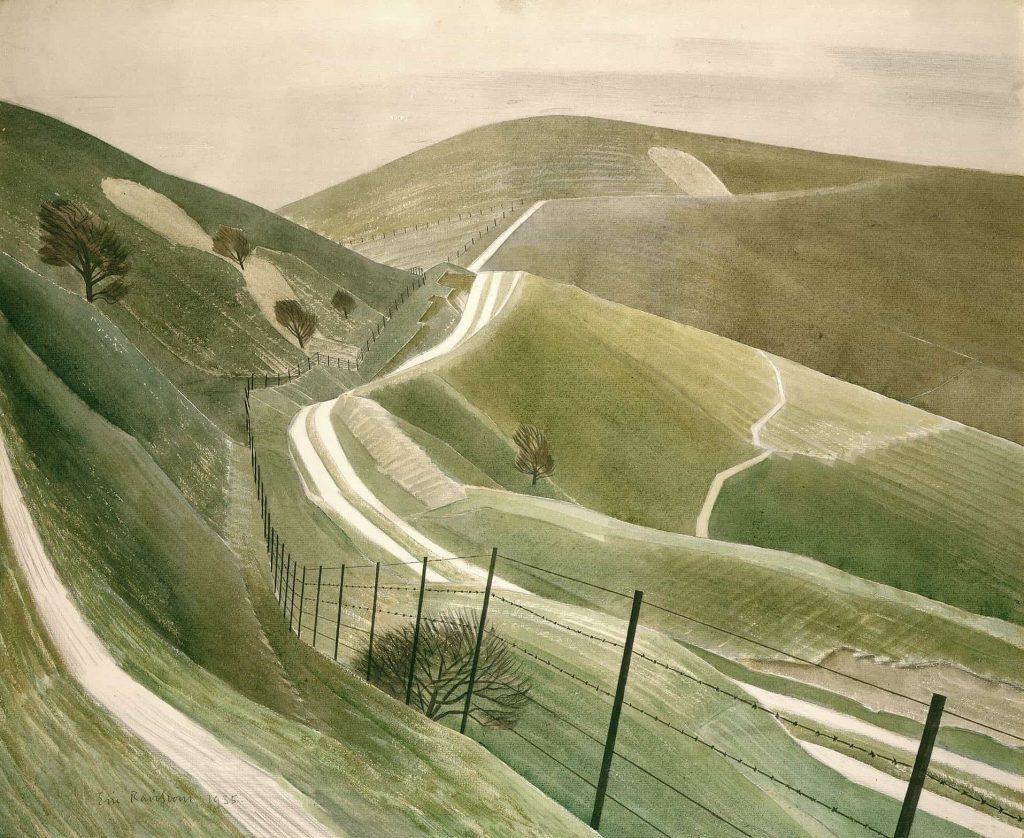
One of Sussex’s defining visual elements is chalk. The county’s chalk cliffs and Downs are not simply scenic features. They create a language of shape, tone and rhythm that has influenced British artists for generations.
Chalk matters because it is both solid and changeable. It gives the landscape its broad structural lines, yet its appearance shifts dramatically with weather and light. Under hard sun it can look luminous and almost abstract. Under rain or low cloud it can flatten into muted greys and greens. From a distance, chalk cliffs can read like clean planes of colour. Up close, they are fractured, crumbly and irregular. That tension between clarity and fragility makes chalk especially rich for painters and photographers.
It also carries cultural meaning. In Sussex, chalk is tied to walking, farming, erosion, archaeology, folklore and the idea of the English landscape itself. Contemporary British artists often inherit that history whether they work directly from the Downs or respond to it more conceptually. For some, chalk becomes a matter of contour and composition. For others, it becomes a sign of impermanence, exposure or vulnerability.
This is what makes Sussex chalk more than a picturesque detail. It can be formal, ecological, historical and psychological all at once. It gives artists a structure to work with, but it also reminds them that the landscape is fragile and changing.
The coast as atmosphere and edge
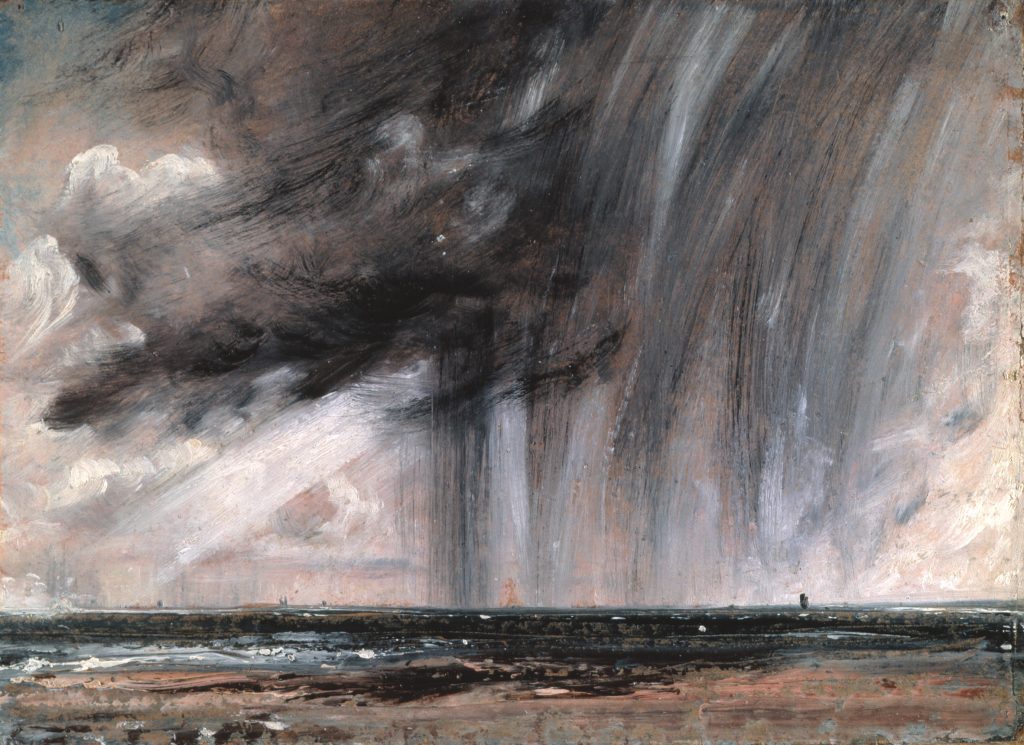
If chalk gives Sussex a strong land based structure, the coast introduces movement and instability. The coastline is one of the county’s great artistic subjects because it is never only a view. It is weather, labour, leisure, erosion, tourism, memory and architecture layered together.
A stretch of Sussex shoreline can be read as open horizon, economic history, holiday space or a site of environmental change. Artists can use it for atmosphere, but also for tension. The coast is where land ends, where weather intensifies, and where human structures meet a larger, shifting force.
Contemporary artists connected to Sussex often respond to this instability rather than trying to tidy it away. They are interested in the fact that the coast changes by the hour. Tide redraws the edge of the land. Light changes the colour of chalk and sea. Sea mist can soften distance until places feel almost unreal. Wind makes even a quiet scene feel unsettled. All of this gives coastal art in Sussex a special tension between permanence and change.
That is one of the best ways to understand Sussex in contemporary art. The county’s coast is not simply painted because it is attractive. It is painted, photographed and reworked because it offers artists a place where change is visible.
Skylines and the overlooked drama of Sussex towns
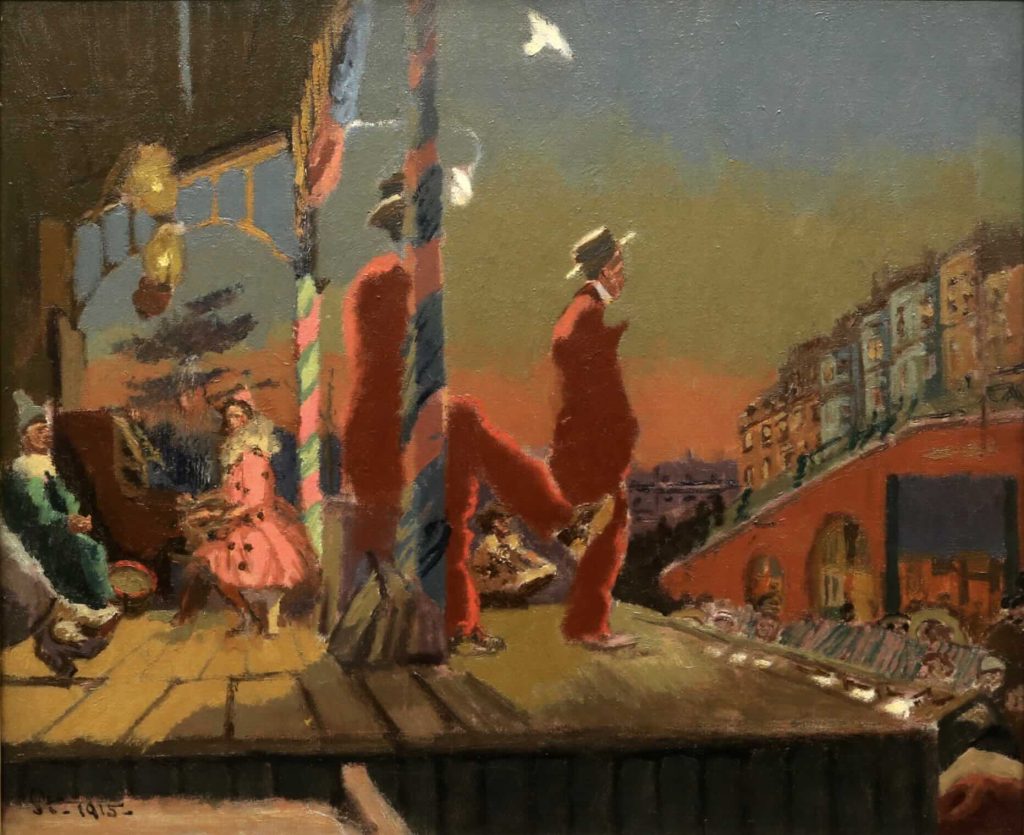
The word skyline often makes people think of major cities, but Sussex has its own distinctive skyline language. Brighton’s piers, pavilions, church spires and seafront terraces create one kind of skyline. Eastbourne, Bexhill and Hastings offer others, where sea horizon meets modernist buildings, fishing structures, net huts and chalk headlands.
These are not anonymous townscapes. They are visually charged boundaries between architecture and open weather. In Sussex art, skyline is rarely only about buildings. It is about how built forms cut into light, cloud and sea.
This is one reason Sussex works so well in contemporary British art. Its skylines complicate the old division between landscape and cityscape. A pier does not cancel the landscape. It enters into it. A pavilion becomes part of coastal light. A church tower can become a vertical interruption in a wide horizontal scene. A gallery building can echo local materials and change how a coastline is read.
That makes Sussex unusually rich for artists working on the boundary between place, structure and atmosphere. A skyline here is not just an outline. It is a meeting point between weather, architecture and memory.
Charleston, modernism and the Sussex inheritance
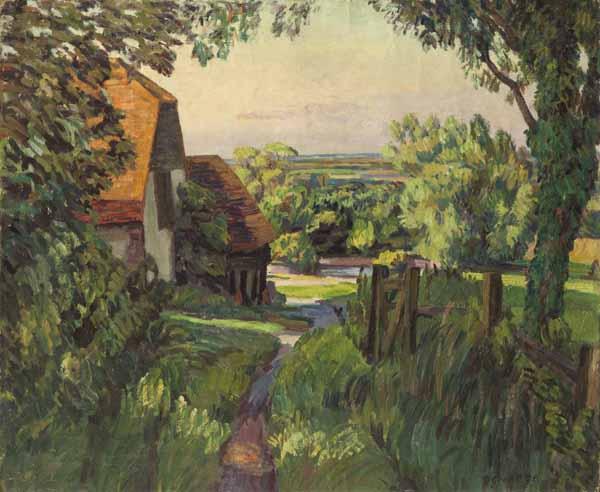
Any serious discussion of Sussex in British art has to acknowledge Charleston and the wider Bloomsbury connection. Although Vanessa Bell and Duncan Grant do not belong to contemporary art in the strictest sense, their presence matters because they helped establish Sussex as a place where landscape and artistic experiment could meet.
Charleston shows that Sussex was never only a rural retreat. It was also a site of formal innovation, domestic reinvention and sustained looking at local surroundings. That legacy still shapes how the county is imagined in British art. Sussex becomes not just somewhere to record, but somewhere to think and make.
For contemporary viewers, this matters because it shows that the county has long supported artists who move between observation and invention, between local subject matter and wider formal concerns. That remains true now whether an artist is painting a skyline in Hastings, photographing chalk paths, or building an installation from place based research.
From historic landscape to contemporary response
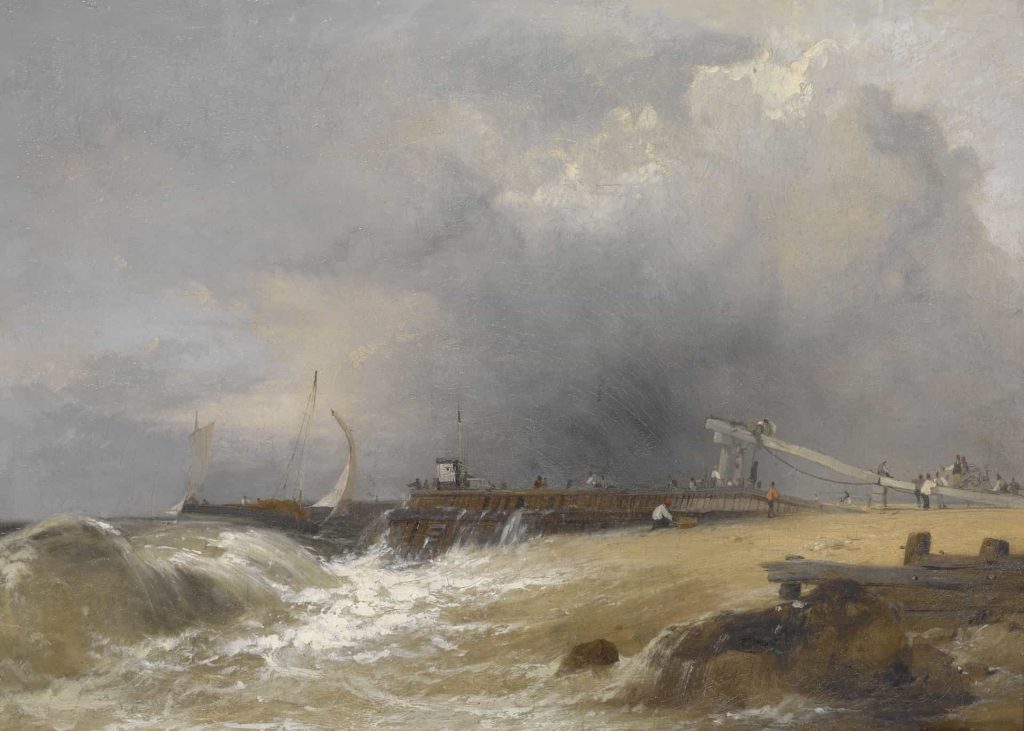
One of the most revealing things about recent Sussex exhibitions is how often they place older and newer work in conversation. This tells us something important. Sussex remains artistically alive not because it is frozen in heritage, but because it can still absorb new methods and concerns.
A contemporary artist does not have to paint Seven Sisters in a traditional way to belong to the Sussex landscape tradition. They can work through photography, digital transmission, installation, abstraction or sculpture and still be responding deeply to place.
This is one of the reasons the idea of Sussex in paint still works even within a broader contemporary frame. Painting remains central, but the visual imagination of Sussex spills across media. Contemporary British art often treats landscape less as a fixed genre and more as a set of questions. How do we picture place now? How do we register environmental fragility? How do coast and town meet? How do weather and time alter what we think we know?
Susan Collins and the digital edge of landscape
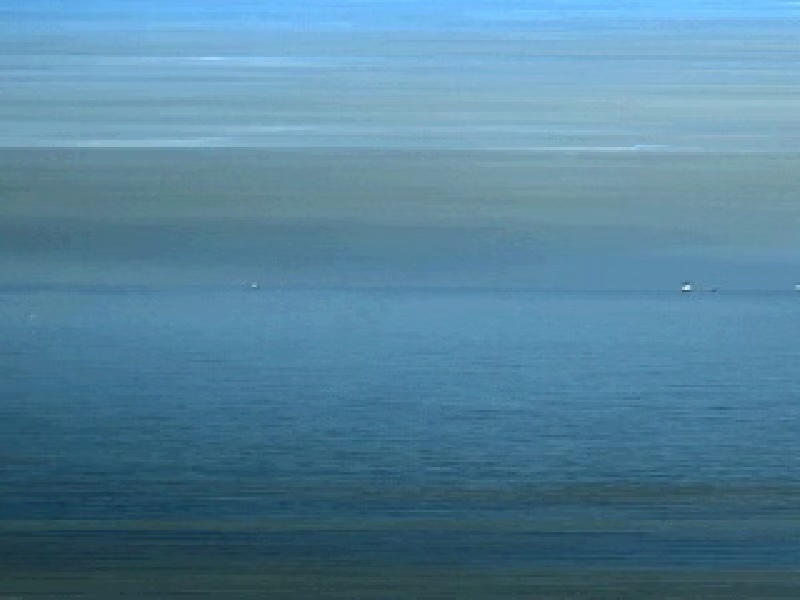
Susan Collins offers a particularly good example of how contemporary artists can renew landscape without abandoning it. Her work shows that a place can be recorded, mediated and experienced through contemporary technology while still remaining about atmosphere, change and attention.
This matters because it shifts the conversation away from simple depiction. The landscape is no longer only painted from direct observation. It can be streamed, processed and re-seen. Yet the underlying concern remains familiar. Artists are still asking about instability, time and the difficulty of fixing a place that is always changing.
For a modern reader, that makes Sussex feel current rather than nostalgic. It shows that place based art in Britain has not been left behind by digital practice. Artists can use contemporary tools to deepen questions that painters have long asked about light, duration and perception.
Wolfgang Tillmans and the photographic Sussex coast
Photography adds another dimension to the Sussex story. It can register haze, glare, flat light and coastal distance with a different kind of precision from paint. But it raises many of the same questions. What makes a coastal place readable? What does a horizon line do emotionally? How much of a landscape is physical, and how much is carried by atmosphere and framing?
This is one reason the Sussex coast continues to work so well in contemporary photography. It can look clear and unstable at the same time. It can feel vast and intimate in the same frame. Sea and sky in Sussex are full of subtle changes that photography can catch without making them feel over-explained.
Photography also helps contemporary viewers notice that Sussex is not only a subject for nostalgic landscape painting. It remains a live visual field, open to new forms of attention and interpretation.
Sophie Barber and the native Sussex coast
A particularly strong contemporary example comes from Hastings. Sophie Barber’s work is rooted in the landscape around her, but it is less about straightforward depiction than about distillation. Rather than simply describing the native Sussex coast, her paintings filter its atmosphere, skies, spaces and textures into something more condensed and internal.
This is an important clue to how contemporary Sussex art often works. The goal is not always to prove that a place exists. It is to translate what that place feels like after it has been lived with, remembered and absorbed. Sussex becomes less a scene and more a set of visual and emotional conditions.
This approach helps explain why contemporary landscape painting still matters. It is not about repeating old landscape conventions. It is about turning visual experience into something more charged, selective and alive. Sussex, with its exposed skies and shifting coast, naturally lends itself to that process.
Jeffery Camp and Beachy Head as recurring subject
Beachy Head remains one of the most potent motifs in Sussex art. It condenses several Sussex qualities into a single place: chalk, height, exposure, sea light and emotional intensity. For artists, it is not only a landmark. It is a meeting point between landmass and void, brightness and danger, stillness and motion.
That is why it can sustain repeated attention rather than just a single picturesque image. Artists return to it because it offers both structure and atmosphere. The cliffs are visually clear, yet emotionally unstable. The scene feels monumental, but also vulnerable. It is a place where geography and feeling become difficult to separate.
This makes Beachy Head one of the strongest examples of how Sussex works in contemporary British art. It is recognisable, but never finished. Artists can keep finding new things in it.
Skylines at Brighton, Bexhill and Hastings
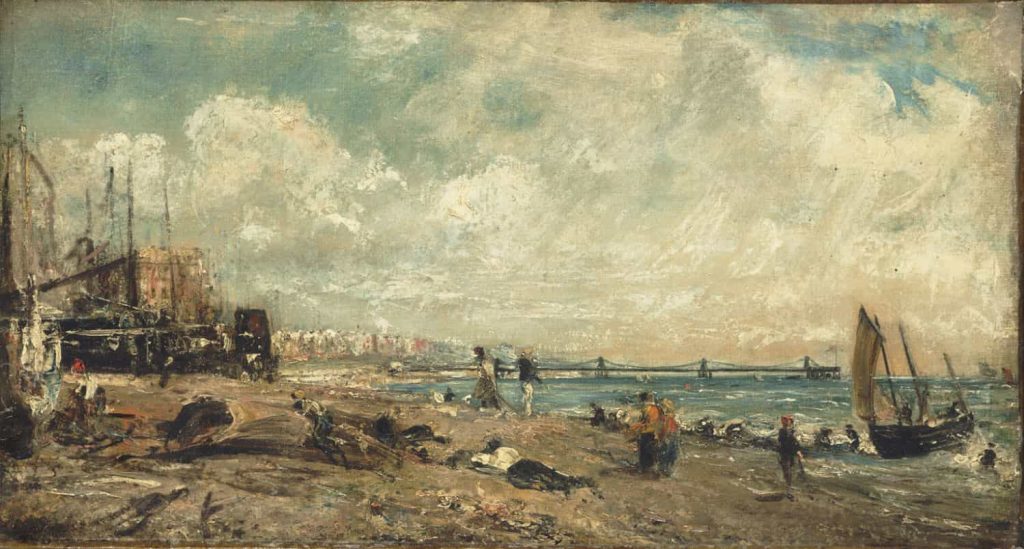
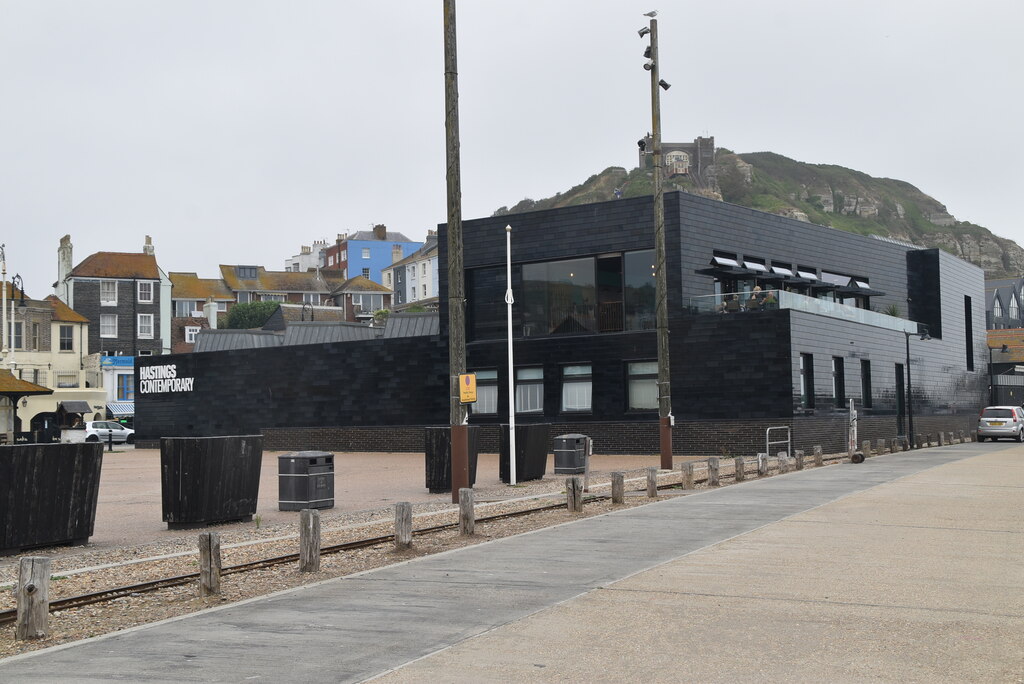
If Beachy Head and the Downs represent Sussex through geology and horizon, Brighton, Bexhill and Hastings show how architecture enters the picture. Brighton’s seafront has long provided artists with a layered skyline of pier, promenade, dome, terrace and weather. Bexhill offers the distinctive modernist line of the De La Warr Pavilion. Hastings combines contemporary architecture with fishing beach structures and black net huts.
These skyline conditions are especially important in contemporary British art because they challenge the old division between landscape and townscape. In Sussex, the skyline is often both at once. A building does not cancel the landscape. It becomes part of it.
This gives artists a striking visual tension. A pier can read as a dark line against sea light. A pavilion can become a shape inside shifting weather. A gallery façade can echo local materials and alter how the horizon is read. That is why Sussex skylines are so artistically productive. They create a dialogue between human form and open environment.
The role of galleries and cultural geography
Contemporary art in Sussex is shaped not only by the landscape itself, but by the county’s cultural geography. Galleries, trails, exhibitions and local institutions help connect artists to place and viewers to the wider story. Chichester, Eastbourne, Bexhill and Hastings all play a role in making Sussex legible as an artistic region rather than a loose collection of isolated sites.
This matters because place in art is not produced by artists alone. It is also supported by exhibitions, conversations, cultural routes and local narratives that help viewers see connections between one work and another. Sussex now has a recognisable contemporary art ecology, one that brings together living artists, historic legacies, modernist architecture and landscape awareness.
That makes the region feel active rather than museum-like. Sussex is not simply a backdrop for established names. It remains a site for living artists at different stages of their careers.
Why Sussex works so well in paint
Paint remains especially suited to Sussex because of the county’s changing light and layered edges. Chalk ridges, sea surfaces and town skylines all benefit from a medium that can be both descriptive and atmospheric. Paint can define a ridge sharply or dissolve it into haze. It can render the hard geometry of a pavilion or the soft shifts of sea mist. It can flatten space or deepen it. It can hold weather as both visual fact and emotional tone.
That flexibility helps explain why Sussex appears so often in painting even now, when artists have many other media available. The county invites painters to work at the edge of control. Too much detail and the atmosphere disappears. Too little structure and the place itself begins to vanish. Sussex painting often lives in that tension, which is one reason it can feel so alive.
How to look at Sussex art in a gallery
If you want to get more from work about Sussex, it helps to ask a few practical questions.
First, what kind of Sussex is being shown? Is it chalk country, wooded interior, fishing coast, resort skyline or estuarine edge? The county contains several visual worlds, and artists usually choose one deliberately.
Second, what is carrying the feeling of the work? In some pieces it will be light. In others it will be weather, colour, scale or structure. In more contemporary work, it may be process or framing rather than direct depiction.
Third, how literal is the artist being? Some works stay close to place. Others distil Sussex into a mood, rhythm or memory. A work can be deeply Sussex without functioning as a straightforward view.
Finally, look at how horizon is handled. In Sussex art, horizons matter. They separate land from sea, town from sky, and certainty from atmosphere. A great deal of the county’s visual power sits right there.
Why Sussex still matters in contemporary British art
Sussex still matters because it gives contemporary artists a landscape that is visually distinctive, culturally loaded and open to reinvention. It supports landscape painting, coastal art, modernist inheritance, photography, sculpture and place based contemporary practice. It gives viewers something recognisable, but it also encourages experimentation.
A chalk path can become a structure for abstraction. A seafront can become an essay on weather and urban form. A skyline can become a way of thinking about memory, tourism or change. In a period when people are newly attentive to environment, regional identity and the politics of place, Sussex feels especially resonant.
Its landscape is beautiful, but it is also inhabited, pressured, historic and changing. That complexity is exactly what contemporary British art needs. Sussex gives artists something solid to begin with, and something unstable to pursue.
Sussex in contemporary British art is far more than a collection of pretty views. It is a rich visual field in which chalk, coast and skyline become ways of thinking about light, weather, memory, structure and belonging.
What makes Sussex special is not just that artists can find beautiful subjects there. It is that the county offers them contrasting systems to work through: the broad grammar of the Downs, the exposed instability of the coast, and the distinctive silhouettes of its towns. Historic figures helped establish this visual inheritance, but contemporary artists continue to remake it through painting, photography, digital practice, installation and sculpture.
To look at Sussex in paint is to look at more than place. It is to look at how artists handle change. Chalk under different light. Sea under different weather. Skylines cut against moving cloud. That is why Sussex remains so potent in contemporary British art. It gives artists something stable enough to begin with, and something shifting enough to keep them looking.
Leave a Reply