
No products in the cart.
Artist of History: Salvador Dalí, Surrealism’s Eccentric Genius
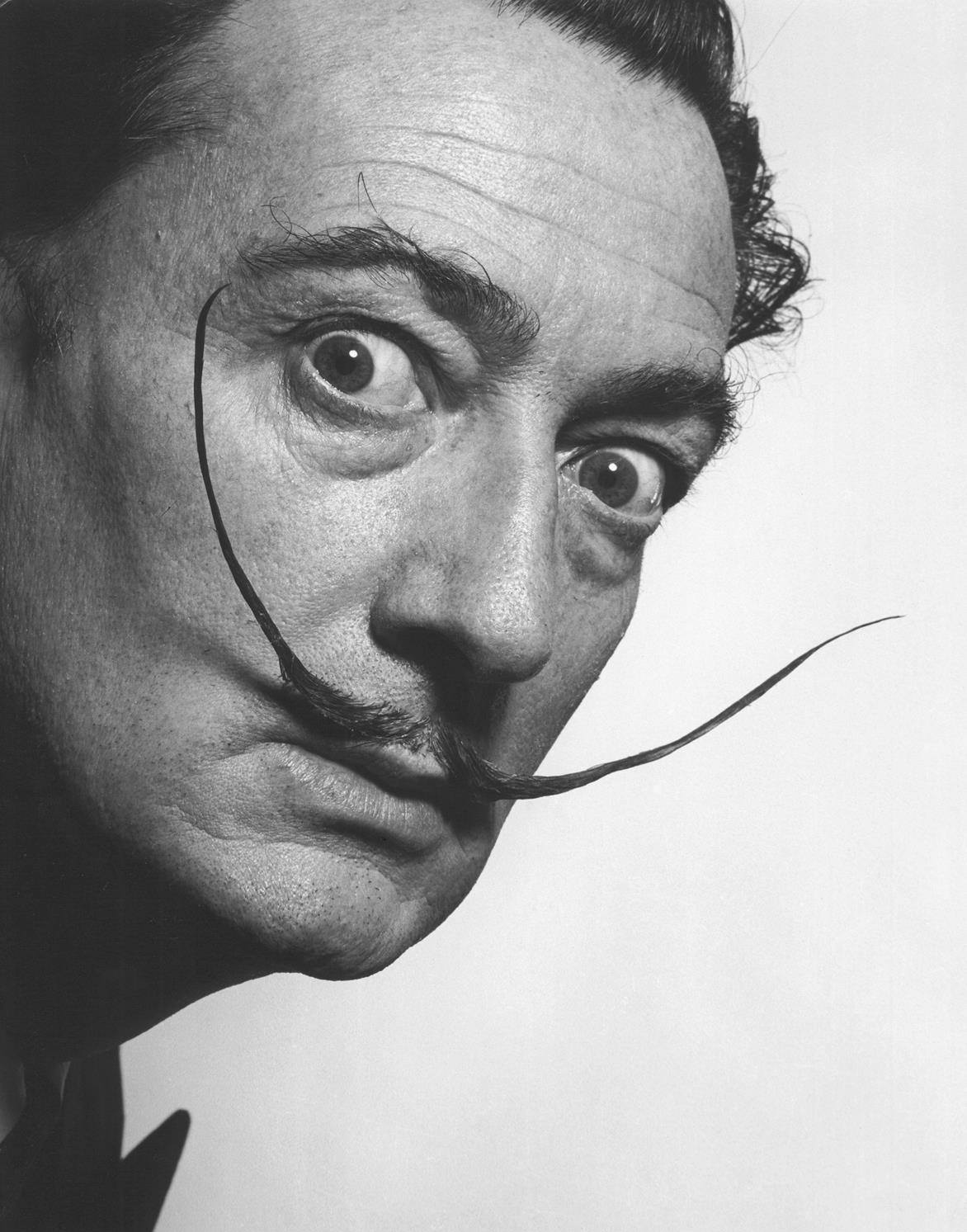
alvador Dalí is one of the few artists whose name instantly triggers a set of images. Melting clocks. Long, spidery legged elephants. A lobster perched where a telephone receiver should be. That impossibly sharp moustache.
He was not only a Spanish surrealist painter but also a draughtsman, writer, designer and performer of his own eccentric public persona. Dalí treated his life as part of the artwork. He wanted people to remember the artist as strongly as the paintings, and he built a body of work that still feels vivid and strange decades after his death.
This longform piece looks at Salvador Dalí as an artist of history and as surrealism’s eccentric genius. It traces his biography, highlights key Salvador Dalí paintings and explores what modern creatives can learn from his mix of technical skill, imagination and self branding.

Library of Congress portrait photo widely treated as public domain in the United States
Early life in Figueres and Cadaqués
Salvador Domingo Felipe Jacinto Dalí i Domènech was born in 1904 in Figueres, a small town in Catalonia in north eastern Spain. His father was a notary, strict and rational. His mother was more indulgent and encouraged his creative side.
Before Dalí was born, his parents had another son, also called Salvador, who died as a child. Dalí grew up with the unsettling idea that he was a kind of replacement, and as a boy he was taken to the grave of his older brother and told he was his reincarnation. That early sense of being a double or a copy runs quietly beneath a lot of Salvador Dalí surrealism, with its split identities and mirror images.
The family spent summers in Cadaqués, a fishing village on the Costa Brava. The rocky coastline, glittering sea and intense Mediterranean light became part of Dalí’s visual memory. When you look at his later surreal landscapes, with their bare cliffs and receding horizons, you are often looking at reimagined fragments of that Catalan coastline.

A precocious art student in Madrid
Dalí showed an interest in drawing from an early age. His parents supported formal training, and he studied at the Municipal School of Drawing in Figueres before moving to Madrid to attend the Royal Academy of Fine Arts of San Fernando.
In Madrid he lived at the Residencia de Estudiantes, a progressive student residence that brought together some of the most interesting young minds in Spain. There he met the poet Federico García Lorca and the filmmaker Luis Buñuel. The three of them argued, experimented and shared ideas about modern poetry, cinema and painting.
As a student Dalí explored several styles. He tried Impressionism, then Cubism and other modern approaches, while also copying Renaissance masters. This mix of traditional skill and avant garde curiosity is important. Later, when Salvador Dalí paintings show impossible dream scenes, they are painted with the precision of an Old Master. That contrast between technique and subject is part of their power.

Paris, surrealism and Gala
In the late 1920s Dalí travelled to Paris, which was then the centre of the European art world. He met André Breton and other members of the Surrealist group. Surrealism was interested in dreams, the unconscious and unexpected juxtapositions of ordinary things. Dalí quickly became one of its most distinctive voices.

In 1929 he collaborated with Luis Buñuel on the film “Un Chien Andalou”. The film opens with a shocking eye cutting sequence and unfolds as a series of loosely connected dream images. Dalí co wrote the script and helped shape the unsettling visual language that made the film a key work of surrealist cinema.
That same year he met Gala, born Elena Ivanovna Diakonova. She was older, Russian born and already part of the Paris avant garde. Gala became his partner, muse and manager. Many works use her as a model, and the figure of Gala appears again and again in Salvador Dalí paintings. Their relationship was complex, sometimes difficult, but central to his life and career.

The paranoiac critical method
Dalí was not content simply to paint strange scenes. He wanted a method for pulling images from the unconscious mind. He called his approach the “paranoiac critical method”.
Rather than painting from observation, Dalí would drift into a state where he encouraged irrational associations and multiple interpretations. He then recorded the results with cool, precise brushwork. The idea was that the painter becomes a kind of controlled paranoid, seeing patterns and double images where other people see ordinary objects.
This method helps explain why so many Salvador Dalí artworks contain hidden faces or forms that appear as one thing at first and then shift into something else. A rock becomes a figure. A landscape becomes a portrait. A group of objects suddenly forms a skull. Dalí wanted the viewer to share his double vision and feel the instability of what they think they see.

The Persistence of Memory and the soft watches
The single most famous Salvador Dalí painting is “The Persistence of Memory”, completed in 1931. It shows a sparse landscape with soft watches hanging over a branch, a ledge and a strange organic object that resembles a distorted self portrait.
The painting is small, but it carries an outsized impact. The clocks look as if they are melting, yet they are painted with exact detail. Flies and ants crawl over the surfaces, making them seem oddly physical and alive even as they sag and lose their shape.
Interpretations vary. Some see the soft watches as a comment on the flexible, unsettling nature of time in the modern world. Others connect them to the feeling of time slowing and bending in dreams. Dalí himself gave different explanations at different moments, which fits his habit of keeping meanings open. What is clear is that the image of Salvador Dalí melting clocks has become an icon of twentieth century art, and it still defines how many people imagine surrealism.


Other key Salvador Dalí paintings
Although “The Persistence of Memory” dominates popular discussion, Dalí’s career is full of other important works that show his range.
“Metamorphosis of Narcissus” reworks the classical myth of Narcissus into a visual riddle. On one side a figure crouches by water. On the other, the same form is echoed in a stone hand holding an egg from which a flower grows. The painting captures transformation, self absorption and rebirth in one tightly structured image.
“Soft Construction with Boiled Beans (Premonition of Civil War)” was painted just before the Spanish Civil War erupted in 1936. It shows a monstrous body tearing itself apart, with twisted limbs locked in conflict. Many viewers see it as a prophetic vision of a country at war with itself.
Later works like “Dream Caused by the Flight of a Bee around a Pomegranate a Second before Awakening” stack symbols in increasingly elaborate ways: tigers leaping from a fish, a bayonet, a sleeping Gala suspended in the air. These paintings show a mature Salvador Dalí still testing how far surrealist imagery can be pushed while keeping a strong sense of structure and rhythm.

The surreal objects: elephants, lobsters and drawers
Dalí did not limit his imagination to flat canvases. He developed a whole menagerie of recurring motifs and surreal objects.
In “The Elephants” he paints tall, fragile, long legged animals carrying heavy obelisks. The contrast between their thin legs and the massive weight on their backs creates a feeling of instability, as if the whole scene might collapse at any moment.
The “Lobster Telephone” combines a real telephone with a model lobster placed where the handset would normally sit. The result is both comic and unsettling. An object associated with communication becomes physically unusable. You can look, but you cannot comfortably speak.
In several sculptures and drawings, human bodies have drawers sliding out of their torsos and hips. Dalí saw these as symbols of hidden thoughts and desires. Open drawers suggest secrets revealed. Closed drawers hint at things deliberately kept out of sight.
These recurring objects help make Salvador Dalí art instantly recognisable. They also work well as semantically related keywords for anyone exploring Dalí surrealism online: Dalí elephants, Lobster Telephone, Dalí drawers, surreal objects, and so on.
War, exile and the American years
The 1930s were turbulent in Europe. In Spain, tension rose between left and right, and in 1936 the Spanish Civil War began. Dalí’s relationship with politics was controversial. Many surrealists were committed to the left, while Dalí avoided firm positions and sometimes made comments that others saw as sympathetic to authoritarian figures. This led to his eventual expulsion from the official Surrealist group in Paris, although he kept working in a broadly surrealist style.

As war spread across Europe, Dalí and Gala left. In 1940 they sailed from Portugal to the United States. They spent much of the 1940s in New York and on the American west coast.
In America, Salvador Dalí became a celebrity as well as an artist. He appeared in magazines, gave lectures, designed shop windows and worked on stage sets. He collaborated with Alfred Hitchcock on the dream sequence for the film “Spellbound”, creating towering eyes, long shadows and symbolic objects for the psychological thriller. He also worked with fashion designers and produced striking images for advertising campaigns.
This period made Dalí financially successful and widened his audience. It also reinforced the idea of Salvador Dalí as an eccentric genius who could move between high art and popular culture with ease.

Return to Spain and nuclear mysticism
In 1948 Dalí returned to Spain. By this point he had publicly embraced Catholicism, and his work shifted towards what he called “nuclear mysticism”. He wanted to combine religious themes with the new physics of the atomic age.
In “Christ of Saint John of the Cross” he paints the crucified Christ from an unusual viewpoint, floating above the scene, with the landscape of Portlligat beneath. The body is solid and idealised, but the surrounding space feels weightless, almost scientific in its clarity.

In “The Sacrament of the Last Supper” and “Leda Atomica” he fragments space into geometric forms, as if reality is built from invisible particles. “The Disintegration of the Persistence of Memory” revisits his earlier soft watches and breaks the once solid landscape into floating blocks, like a world dissolving into its smallest components.
These paintings show that Salvador Dalí was not stuck in a single surrealist phase. He kept folding in new influences, from nuclear science to religious mysticism, while still using the precise, detailed painting style he had developed as a young artist.
Dalí as performance and brand
Alongside the paintings, Dalí built a highly visible public persona. The upward pointing moustache, the walking stick, the capes and canes, the eccentric one liners in interviews, all of these were carefully maintained.
He knew that in a mass media age, the image of the artist could be as powerful as the image on the canvas. Dalí turned himself into a living logo. At a time when most artists tried to appear serious and withdrawn, he stepped forward as entertainer and provocateur.
One famous moment came at the International Surrealist Exhibition in London in 1936. Dalí gave a lecture while wearing a deep sea diving suit and helmet, holding a billiard cue. He claimed he was exploring the depths of the subconscious. In practice he nearly suffocated and had to be rescued, but the photographs travelled widely and cemented his reputation as surrealism’s most theatrical figure.
This ongoing performance was not just vanity. It kept attention on Salvador Dalí art and helped him secure commissions, exhibitions and collaborations. In many ways he anticipated how artists and creatives now use media and self presentation to build their own audiences.

The Dalí Theatre Museum and the Dalí Triangle
Later in life Dalí focused on creating a museum that would function as a total work of art. In the 1960s and 1970s he worked on transforming the ruins of the old municipal theatre in Figueres into the Dalí Theatre Museum. It opened to the public in 1974.
From the outside, the building is immediately recognisable. The walls are topped with giant sculpted eggs and golden figures. Inside, the courtyard contains a multi level installation with a vintage car, a boat and other surreal elements. The galleries hold paintings, sculptures, objects and a bedroom arranged so that, when seen from a certain point, the furniture forms the face of the actress Mae West.
Dalí lived for periods in the museum and is buried there in a crypt beneath the former stage. The site is now a central destination for anyone serious about Salvador Dalí biography or Dalí tourism, because it reveals how he wanted his work to be seen as a complete environment.
Together with his house in Portlligat and the castle in Púbol, where Gala lived for part of the year, the Theatre Museum forms what is often called the Dalí Triangle in Catalonia. Each place shows a different aspect of the artist: the working studio, the private retreat, the public spectacle.

Legacy and influence of Salvador Dalí
Salvador Dalí died in 1989, but his influence has hardly faded. His images appear in films, music videos, fashion editorials and album covers. The melting clocks and surreal landscapes are used in adverts and referenced in graphic design.
Television series and films have used his face or persona as a symbol of rebel creativity. Artists and designers continue to borrow from his palette of dream images. Even people who do not know much about art history usually recognise at least one of his paintings.
At the same time his legacy is carefully managed by the foundation set up in his name. Museums around the world hold important Salvador Dalí collections, and new exhibitions continue to reinterpret his work in the light of current concerns, from psychology to science and media culture. There have also been disputes and investigations around forged prints and unauthorised editions, which show how strong the market remains for anything associated with his name.
What modern creatives can learn from Dalí
For artists, designers and content creators today, Salvador Dalí offers several practical lessons.
First, skill matters. Behind the wild images is a painter who studied classical techniques, anatomy and perspective. The surrealism works because the viewer believes in the reality of what they see, even when it is impossible.
Second, experimentation can sit alongside discipline. Dalí allowed himself to drift into irrational associations through the paranoiac critical method, but he edited, refined and structured those visions on the canvas.
Third, a clear visual vocabulary helps people remember you. Dalí reused certain motifs again and again: clocks, crutches, drawers, elephants, eggs, craggy seashores. This repetition built a recognisable brand, long before branding language was common in the art world.
Fourth, he understood the power of story and place. Visitors travel to Figueres, Portlligat and Púbol not just to see individual works, but to step into the narrative of Salvador Dalí’s life and surroundings.
Finally, Dalí shows that being a “serious” artist does not mean being dull. He could be playful, theatrical and even absurd without losing depth. For anyone trying to create memorable, human content, that blend of craft, surprise and personality is still a useful model.
Salvador Dalí remains one of the defining figures of twentieth century art. Born in a small Catalan town, he moved through Madrid, Paris, New York and back to Spain, leaving a trail of unforgettable images and stories.
As a Spanish surrealist artist, he turned private dreams into public icons. As a performer, he blurred the boundary between artist and artwork. As a builder of museums and places, he shaped how future generations would encounter his legacy.
To think about Dalí is to think about how imagination, technique and self invention can combine into something larger than a single painting or sculpture. That is why, even in an age saturated with images, Salvador Dalí still feels like surrealism’s eccentric genius and an artist of history worth returning to again and again.
Leave a Reply