
No products in the cart.
Top Artist of History: René Magritte: The Surrealist’s Enigma
René Magritte is one of those rare artists whose images remain instantly recognisable even to people who do not usually follow art history. A man in a bowler hat with his face hidden by an apple. A pipe with the words “This is not a pipe.” Two lovers kissing through cloth. A bright blue sky above a night time street. A giant eye filled with clouds. These works have moved so deeply into modern visual culture that they can feel familiar long before people know his name.
That familiarity can be misleading. Because Magritte’s paintings are so clean, so legible and so widely reproduced, they are sometimes treated as clever visual puzzles or stylish surreal images with a hint of mystery. In reality, his work is much sharper than that. Magritte was not simply painting strange scenes to amuse or confuse viewers. He was using ordinary objects to challenge ordinary thought. His paintings question language, representation, identity, visibility and the relationship between what we see and what we think we know.
This is why Magritte still matters so much. He did not chase the wild, melting dream world often associated with popular ideas of Surrealism. Instead, he painted with clarity. He kept his style calm, plain and readable, then placed familiar things into unfamiliar relations. A train comes out of a fireplace. A man becomes a bourgeois symbol rather than an individual. A painted window and a real landscape seem to switch places. A title refuses to explain the image. The effect is unsettling precisely because it is so matter of fact.
For readers searching for René Magritte, who René Magritte was, why Magritte is famous, René Magritte paintings, The Son of Man, The Treachery of Images, The Lovers, Empire of Light, Belgian Surrealism or how to understand Magritte, the deeper question is usually the same. Why do these paintings stay in the mind so powerfully? Why does Magritte still feel so modern? And what makes his version of Surrealism different from the more theatrical dream worlds of artists such as Salvador Dalí?
This guide explores Magritte’s life, key works, symbols, methods and lasting influence in a clear way. It looks at how he became one of the defining painters of Surrealism, why he turned ordinary objects into philosophical traps, and how to look at his paintings without reducing them to simple riddles. The aim is not only to explain Magritte’s art, but to show why his paintings still feel so sharp in a culture full of images, slogans, surfaces and uncertainty.

Who was René Magritte?
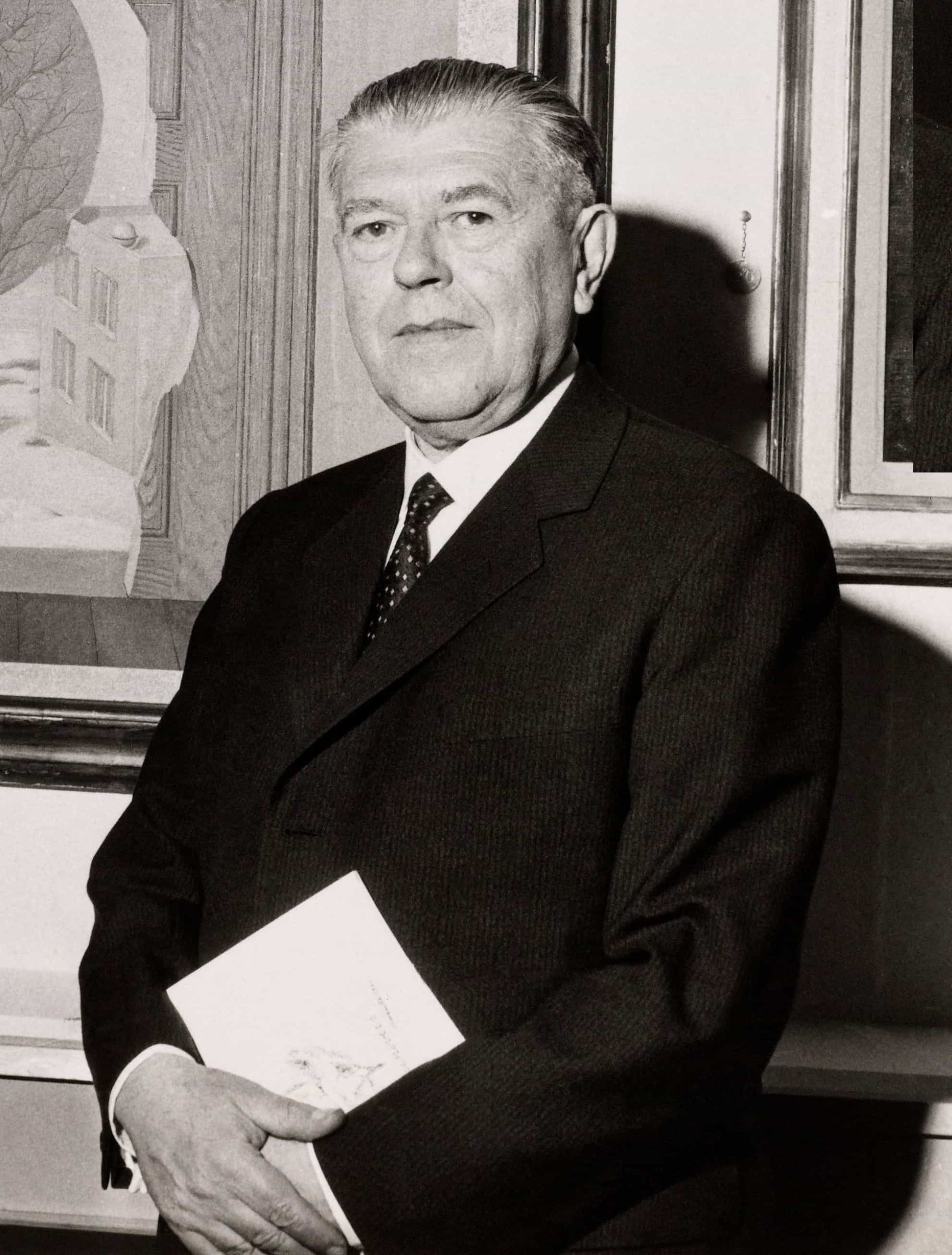
René Magritte was born in 1898 in Lessines, Belgium, and became one of the most important painters associated with Surrealism. He studied at the Académie Royale des Beaux-Arts in Brussels and worked for a time in commercial design and advertising before fully developing the style that would make him famous.
That early connection to design and visual messaging matters. Magritte understood how images communicate in everyday life. He knew the force of familiar objects, recognisable symbols, printed language and visual directness. His paintings often retain that clarity. Unlike artists who built dense surfaces or dreamlike atmospheres, Magritte preferred an almost neutral precision. He painted objects plainly, then let the strangeness emerge through their combination.
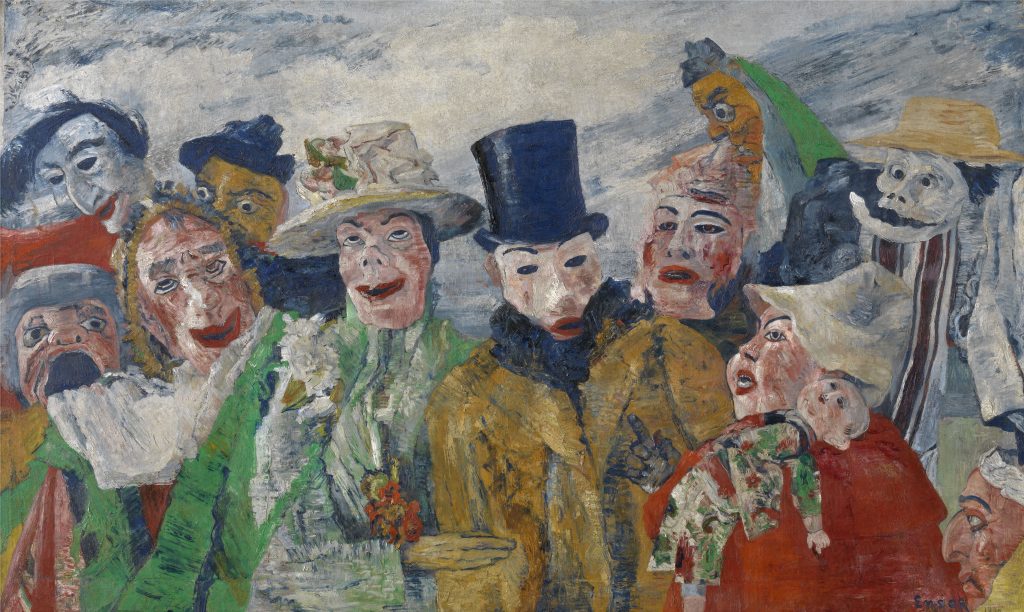
His life was centred largely in Belgium rather than in the more mythologised Parisian art world. Although he spent time in Paris in the late 1920s and was involved with Surrealist circles, he remained a distinctly Belgian artist in tone and outlook. His work is often cooler, more restrained and more philosophical than the popular stereotype of Surrealism might suggest.
He died in Brussels in 1967, but by then he had already built one of the most influential bodies of work in twentieth century art. His paintings continue to shape not only fine art but also graphic design, advertising, photography, fashion, film and popular visual culture.
Why Magritte became so important
Magritte became important because he found a way to make painting think.
That may sound abstract, but it describes his art well. He did not use painting only to depict things. He used it to ask questions. What is the relationship between an object and its name? What happens when a familiar thing appears in the wrong context? What do images hide while pretending to reveal? Why do some pictures feel understandable at first and then become stranger the longer you look?
Many artists make images that are emotionally powerful. Magritte’s special achievement was to make images that are intellectually disturbing without losing their visual grip. His paintings are easy to enter because the objects are familiar. But once inside them, you realise the logic has shifted.
This makes his work unusually memorable. A Magritte painting often begins with recognition and ends with uncertainty. That movement is one of the reasons his art has lasted. He gives viewers something to hold onto, then quietly removes the ground beneath it.
He also became important because he created one of the most distinctive visual languages in modern art. Bowler hats, apples, curtains, windows, clouds, pipes, birds, rocks, candles, doorways and faceless men recur across his work. These are ordinary things, but in Magritte’s hands they become tools for questioning reality itself.


This pair works well because it lets you show Surrealism nearby, but not identical. Tanguy gives you full dream terrain, which helps you explain why Magritte’s own version of Surrealism felt calmer, sharper and more philosophical.
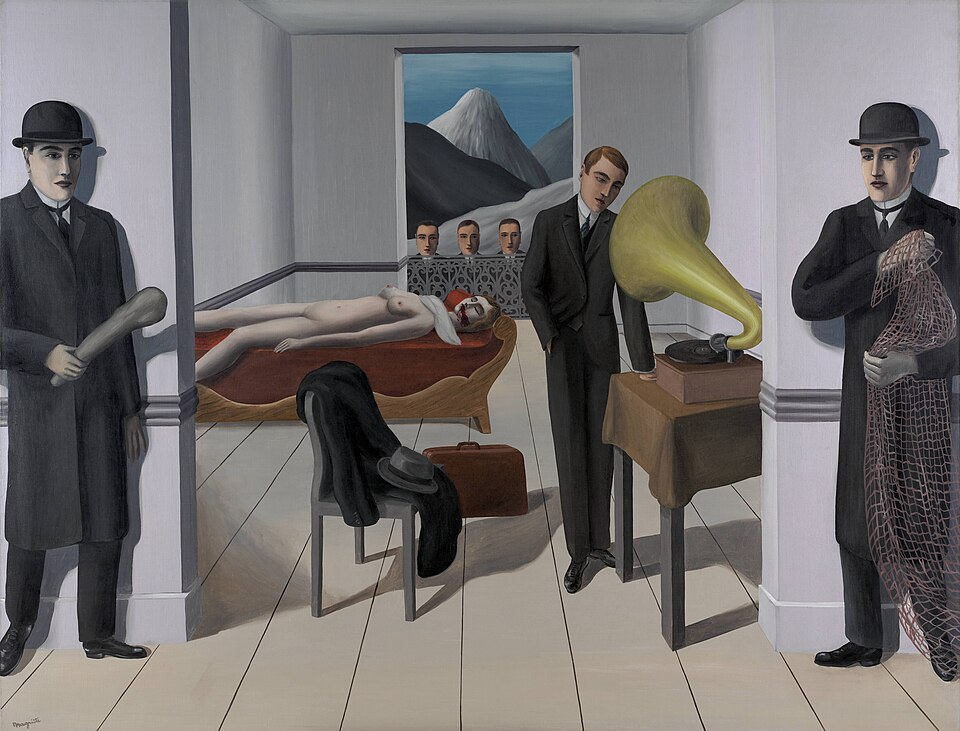
What makes Magritte different from other Surrealists
When people think of Surrealism, they often imagine dream imagery, melted forms, bizarre creatures or wildly irrational worlds. That version of Surrealism exists, but Magritte occupies a slightly different place within it.
Where Salvador Dalí often pursued a highly theatrical, fevered and illusionistic dream language, Magritte tended to work through clarity and understatement. His paintings usually look calm. The brushwork is controlled. The space is readable. The objects are familiar. The strangeness does not come from visual chaos. It comes from the relationship between things.
This is a crucial difference. Magritte’s art is not mainly about irrationality exploding across the canvas. It is about reason encountering its limits. His images feel almost logical until they suddenly are not. They are composed like statements, but statements that undo themselves.
This is one reason his work feels so contemporary. It anticipates a world where images look clear, polished and direct, yet remain unstable in meaning. Magritte understood that the ordinary can be stranger than fantasy if seen in the right way.
The ordinary object as a source of mystery
One of Magritte’s greatest strengths was his ability to turn ordinary objects into sites of mystery. He did not need monsters or elaborate dream worlds to make the viewer uneasy. He could do it with a pipe, a window, a hat, a cloud or a stone.
This matters because it changes how his paintings operate. They do not ask us to escape the real world entirely. They ask us to notice how strange the real world already is when language, image and expectation are pulled slightly out of alignment.
Take the pipe in The Treachery of Images. It is painted clearly and recognisably. Below it, Magritte writes, “Ceci n’est pas une pipe,” usually translated as “This is not a pipe.” The statement is perfectly true, because the painting is not an actual pipe. It is an image of a pipe. Yet the work feels provocative because it exposes how quickly we confuse image and thing.
This is typical of Magritte. He takes something so obvious we barely notice the assumption inside it, then makes that assumption visible.
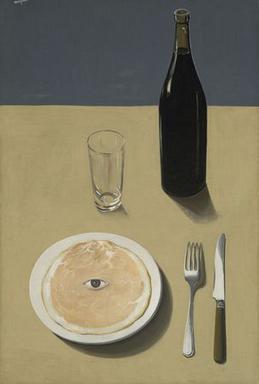
The Treachery of Images and the problem of representation
If you had to choose one Magritte painting that explains his importance, The Treachery of Images would be one of the strongest choices. It is simple, direct and conceptually powerful.
The painting shows a pipe. Beneath it appears the sentence “This is not a pipe.” At first the statement seems absurd, but it is also exact. The painting is not a pipe. It is only the representation of one.
This work matters because it turns representation itself into the subject. It reminds viewers that words are not things, images are not things, and seeing something depicted does not give us the thing itself. That may sound obvious once stated, but Magritte shows how deeply everyday life depends on forgetting this distinction.
The power of the painting comes from its clarity. There is no visual complication to distract from the thought. Magritte gives the viewer a lesson in representation, but in the form of an image that remains funny, elegant and slightly unsettling.

The Son of Man and the hidden face
The Son of Man is one of Magritte’s most famous works, and it has become almost a shorthand for his art as a whole. A man in a bowler hat stands before a low wall with sea and sky behind him. His face is hidden by a floating green apple.
The image is clean and memorable, but its real power lies in how it stages concealment. The sitter is dressed conventionally, standing still, apparently available to view. Yet the face, the part we most expect to reveal identity, is blocked.
This creates a tension Magritte explored repeatedly. We are shown a person and denied the part of them we most want to see. The painting becomes a meditation on visibility and frustration. We never fully get access to the subject.
Magritte himself commented on the tension between the visible that is present and the visible that is hidden. That insight is central to much of his work. His paintings often show that what is concealed can become more powerful than what is disclosed.
The Son of Man has lasted so strongly in popular culture because it condenses one of Magritte’s biggest ideas into a single unforgettable image: revelation is always partial.
The Lovers and intimacy blocked
Another of Magritte’s best known paintings is The Lovers, in which two figures kiss with their heads wrapped in white cloth. It is one of the most haunting images in modern art because it turns intimacy into obstruction.
A kiss is usually imagined as closeness, connection and access. Magritte paints the opposite. The figures are physically near, but something remains between them. The cloth prevents real contact even at the moment of apparent union.
This gives the work its emotional power. It can be read in several ways. It may speak to the limits of love, the unknowability of other people, desire frustrated by distance, or the fact that intimacy never fully removes mystery. The painting is simple, but it opens into large psychological territory.
It also shows how Magritte could be emotionally resonant without becoming sentimental. His images are controlled, but they are not cold. The best of them carry feeling through structure rather than overt drama.
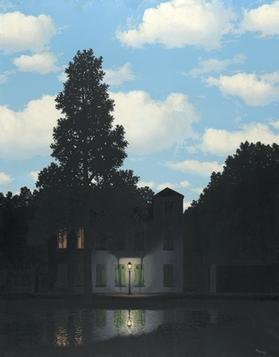
The Empire of Light and impossible time
The Empire of Light is one of Magritte’s most beautiful and unsettling ideas. The painting shows a quiet street at night, complete with darkened houses and lamplight, beneath a bright blue daytime sky filled with clouds.
The image is impossible, but it does not feel chaotic. In fact, it feels strangely calm. This calmness is what makes it so effective. Magritte is not relying on monstrous distortion. He is combining two incompatible times of day within a single image and letting the contradiction remain perfectly composed.
This painting matters because it shows how Magritte used landscape and atmosphere philosophically. He turns time itself into a visual paradox. Day and night exist together, and neither cancels the other.
The result is one of his clearest demonstrations that the familiar world can become profoundly strange with only a slight change in logic. The street, the sky, the tree and the house all remain recognisable. Yet the world they belong to is no longer stable.
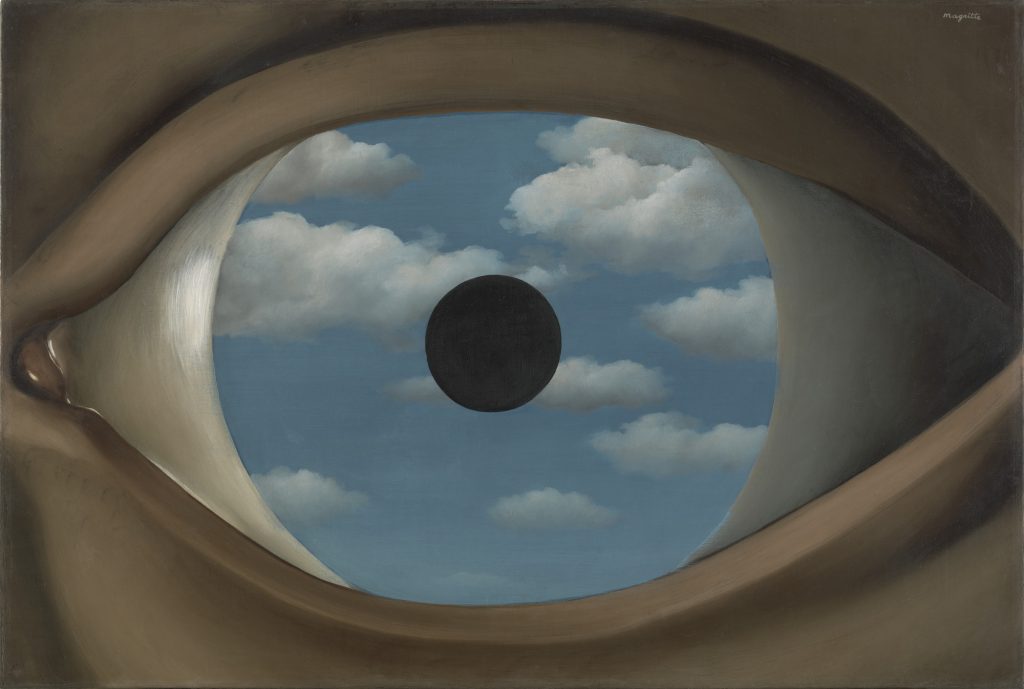
The False Mirror, the eye and the problem of seeing
In The False Mirror, Magritte paints a giant eye whose iris is replaced by a bright blue sky with clouds. It is one of his most elegant images because it fuses the act of seeing with the world seen.
The eye here is not merely an organ of vision. It becomes a picture field. At the same time, the title suggests deception. The eye, which we rely on for truth, becomes a false mirror. Seeing is not presented as innocent or complete.
This is a major Magritte theme. Vision is never purely transparent. We do not simply receive the world. We interpret it, frame it and project onto it. The painting makes this visible with extraordinary economy.
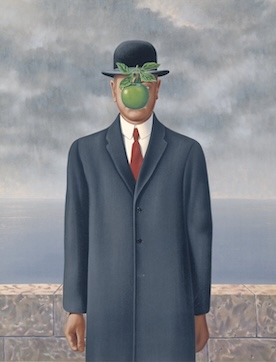
The Son of Man (1964) by René Magritte (1898-1967)
Magritte and the bowler hat man
The bowler hat is one of Magritte’s signature motifs, and it appears again and again in paintings featuring anonymous men in coats. These figures are often treated as mysterious, but they are also deeply ordinary. They resemble respectable middle class men, bureaucrats, commuters, or citizens of a quietly ordered world.
This matters because the bowler hat man is not a romantic hero. He is a symbol of conventional identity, repetition and social normality. By multiplying or obscuring this figure, Magritte turns social conformity itself into something eerie.
In works such as Golconda, where numerous bowler hatted men float or fall through space, the effect is both comic and unsettling. The repeated figure becomes a sign of modern anonymity. Individuality has been absorbed into pattern.
This helps explain why Magritte still feels relevant. He understood the tension between public appearance and hidden self. His bowler hat men are recognisable, yet strangely empty. They look like people, but they also behave like symbols.
Words and images
Magritte was unusually attentive to the relationship between text and image. The Treachery of Images is the most famous example, but it is not the only one. Across his work, he repeatedly explored how language fails to coincide neatly with the things it names.
This concern gives his art a philosophical edge. Many paintings raise questions that feel close to linguistics or semiotics, even before those terms became widely used in art discussion. He understood that a word points to a thing without being the thing, and that an image does something similar. His paintings often sit in the gap between naming and seeing.
This is one reason Magritte influenced later conceptual artists so strongly. He demonstrated that painting could think about signs, categories and representation without ceasing to be visually compelling.
Titles as part of the enigma
Magritte’s titles are famous because they rarely explain the painting in a straightforward way. Instead, they deepen the strangeness. A viewer expects the title to help clarify what they are seeing, but Magritte often uses it to open another layer of uncertainty.
This is important because it prevents the painting from being reduced to a solved riddle. His titles do not act like captions. They create friction between word and image. A work might be called The Human Condition, The Listening Room, Personal Values or Not to Be Reproduced, yet the title does not close the meaning. It complicates it.
This use of titles reflects Magritte’s wider distrust of easy explanation. He wanted his paintings to remain alive as problems. If a title could pin the image down too neatly, the mystery would collapse.
How to read a Magritte painting
The easiest mistake with Magritte is to treat every painting like a puzzle that has one hidden answer. That approach can flatten the work quickly. A better way is to ask what kind of tension the painting creates.
Start with the ordinary element. What objects, spaces or situations are familiar here?
Then ask what has changed. Has an object grown too large? Has a face been concealed? Have inside and outside reversed? Are day and night occupying the same image? Is language contradicting sight?
Then ask what that change does to your sense of reality. Does it create unease, humour, philosophical doubt, sadness, absurdity or distance?
Finally, notice how calm the image remains. Magritte rarely paints in a frantic way. His surfaces often feel controlled and clear. This matters because the strangeness arrives through logic rather than painterly chaos.
If you approach his work this way, you stop asking only “What does it mean?” and start asking “What assumption is this painting disturbing?” That question usually takes you further.
Magritte and popular culture
Few twentieth century artists have travelled into popular culture as widely as Magritte. His imagery appears in advertising, book covers, album art, fashion editorials, films and graphic design. The bowler hat, the apple, the pipe and the cloud filled sky have all become reusable cultural symbols.
This widespread influence is partly a testament to the strength of his images. They are concise, direct and adaptable. But it also creates a risk. Because Magritte’s works are so often quoted, they can be mistaken for decorative surreal icons rather than rigorous works of thought.
It is worth resisting that flattening. Magritte’s images survive in popular culture not because they are merely quirky, but because they contain durable tensions: appearance and concealment, language and image, ordinary life and metaphysical doubt. These tensions remain highly reusable because they still describe modern experience.
The man behind the enigma
Magritte’s public image can seem quieter and more ordinary than that of some Surrealists. He was not a flamboyant self mythologiser in the way Dalí became. Photographs often show him looking like one of his own bowler hatted men: composed, suited and reserved.
This is part of what makes him interesting. His art does not come from theatrical eccentricity. It comes from a very deliberate, disciplined intelligence. He once said he painted visible images which conceal nothing, and that they evoke mystery. That sentence captures his whole approach. He did not want to bury meaning inside obscure symbols. He wanted to make mystery arise in full view.
This helps explain the peculiar power of his work. The enigma is not hidden behind elaborate technique. It is placed calmly before us.
René Magritte’s most famous paintings you should know
If you are new to Magritte, these are among the works most worth knowing.
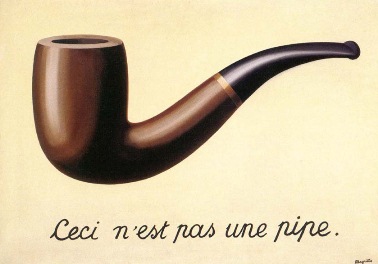
The Treachery of Images, 1929
The classic word image painting that shows a pipe and declares that it is not a pipe. Essential for understanding his thinking about representation.
The Lovers, 1928
A haunting image of intimacy blocked by cloth. One of his most emotionally resonant works.
The Son of Man, 1964
A self portrait of concealment and one of the most recognisable paintings of the twentieth century.
The Empire of Light, multiple versions from the late 1940s onwards
An impossible fusion of day and night, and one of Magritte’s most beautiful visual paradoxes.
The False Mirror, 1929
A giant eye whose iris is a sky. A key work on seeing and perception.
Golconda, 1953
Repeated bowler hatted men suspended through space. A powerful image of anonymity, repetition and modern identity.
Time Transfixed, 1938
A train emerging from a domestic fireplace. A perfect example of Magritte’s ability to make the impossible seem matter of fact.
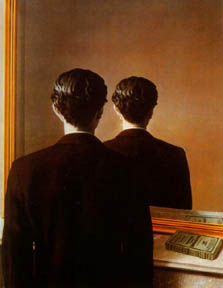
Not to Be Reproduced, 1937
A portrait reflected in a mirror, but the reflection shows the back of the subject again rather than the face. One of his most elegant works on selfhood and representation.
Why Magritte still matters now
Magritte still matters because he understood how unstable images are.
We now live in a culture where pictures circulate constantly, where language shapes perception, where public identity is performed through repeated visual symbols, and where surfaces often look clear while meaning remains slippery. Magritte anticipated all of this. He saw that the ordinary image could be a trap, that words and pictures do not line up neatly, and that visibility does not guarantee truth.
This is why his paintings continue to feel modern rather than merely historical. They are not only about Surrealism as a movement. They are about the structure of seeing itself.
He also matters because he kept art intellectually alive without making it visually dry. His paintings remain memorable because they are both philosophical and visually exact. They attract first, then disturb. They are readable, but never exhausted.
For contemporary viewers, that combination remains rare and valuable.
Common misconceptions about Magritte
He just painted weird things
Not really. Magritte painted ordinary things in ways that expose the limits of ordinary thought. The point is not weirdness for its own sake.
He was the same as Dalí
Both are major Surrealists, but their approaches differ significantly. Dalí often works through dreamlike excess and illusionistic drama. Magritte works through clarity, calmness and conceptual tension.
His paintings are puzzles with one answer
Usually not. The strongest Magritte paintings remain open. They create a structured mystery rather than a single solution.
He was only important in art history
His influence remains very active in contemporary visual culture, especially wherever images, symbols, language and identity are being questioned.
How to get more from Magritte in a gallery
If you encounter Magritte in a gallery, take a little more time than you think you need.
Notice how plain the painting style often is. This is deliberate. He wanted the objects to remain recognisable.
Look for the exact point where the ordinary turns strange. There is usually one shift that reorganises the whole image.
Read the title and then look again. Ask whether the title helps, misleads or complicates the image.
Resist the urge to decode it too quickly. Magritte’s paintings are strongest when they stay slightly unresolved.
Think about what kind of assumption the painting is quietly undoing. That question often opens his work more effectively than hunting for hidden symbols.
René Magritte became one of the defining artists of Surrealism not because he painted the wildest fantasies, but because he found the mystery already present inside ordinary things. He understood that a pipe, a hat, a window, a cloud, a face or a word could all become unstable if placed under the right pressure. His paintings look calm, but they think sharply. They make the familiar strange without ever abandoning the familiar altogether.
That is why he remains so compelling. Magritte does not only give viewers memorable images. He gives them problems they can keep returning to. What do pictures actually show? What do they hide? How do words shape what we think we see? How much of reality depends on habits we rarely question?
The best Magritte paintings do not answer these questions completely. They leave them hanging in front of us, clear and unresolved. That is the enigma, and it is what keeps the work alive.
To understand Magritte is not simply to recognise the apple, the bowler hat or the pipe. It is to recognise that his art keeps testing the ground beneath our certainties. That is why he still matters, and why his paintings continue to feel as fresh, unsettling and intelligent as ever.
Leave a Reply